
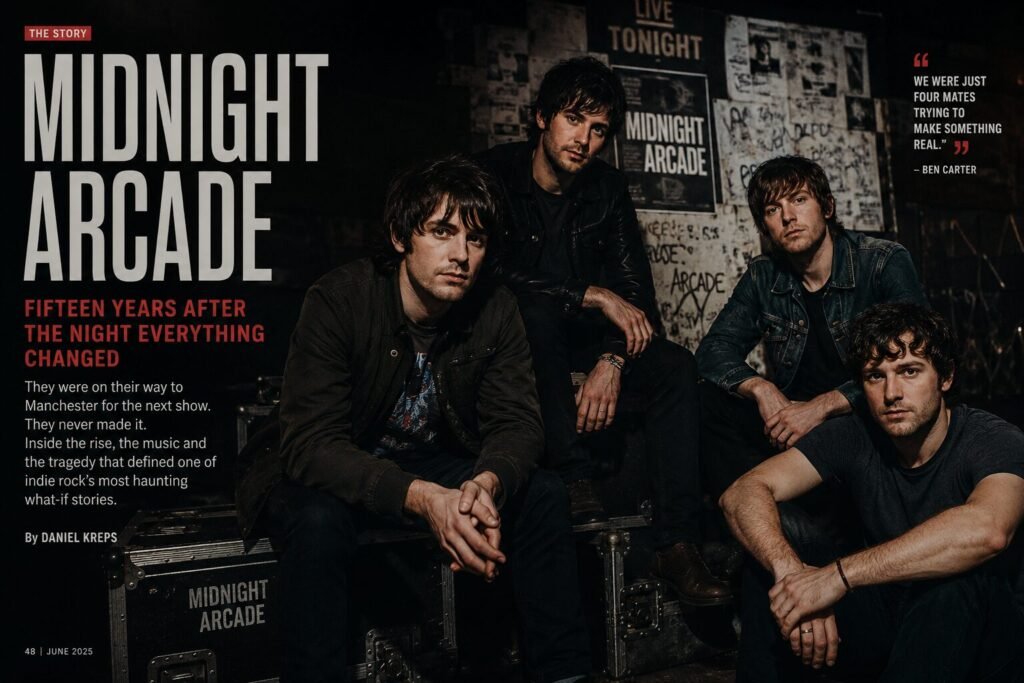
Fifteen years is a long time in music.
Long enough for entire genres to rise and fall. Long enough for chart-topping artists to disappear from public memory. Long enough for bands that once seemed destined for greatness to become little more than names buried in old festival posters and forgotten playlists.
Yet some stories endure.
Fifteen years after the crash that ended Midnight Arcade, people are still talking about them.
Not because they were Britain’s biggest band.
Not because they sold millions of records.
But because they were standing on the edge of something.
And then, suddenly, they weren’t.
For those who remember them, Midnight Arcade represent one of British indie music’s most enduring “what if?” stories. For younger listeners discovering them through streaming services, they are a band whose music feels strangely timeless despite a career cut painfully short.
Their story remains compelling because it never reached a conclusion.
The final chapter was never written.
Four Friends Chasing Something Bigger
Midnight Arcade were not manufactured.
They were not assembled in a boardroom.
They were not the product of a television talent show.
They were four friends who spent years dragging equipment through side entrances, loading vans in the rain and performing for audiences small enough to fit comfortably inside a pub function room.
Frontman Ben Carter, guitarist Ryan Hale, drummer Marc Ellis and bassist Danny Walsh built their reputation the way most successful bands once did: one gig at a time.
Their sound blended atmospheric indie rock with anthemic choruses and emotionally direct songwriting. They weren’t reinventing the genre. They were simply very good at making people care.
That mattered.
Audiences connected with Midnight Arcade because they felt authentic. Their songs carried the rough edges of lived experience. Their performances felt earned rather than rehearsed for social media clips.
Promoters began noticing.
Then local radio stations.
Then industry figures.
The crowds grew slowly but consistently.
There was no overnight explosion.
Just momentum.
The kind that musicians dream about because it tends to last longer than hype.
Run With the Lights On
Every band has a song that changes everything.
For Midnight Arcade, it was Run With the Lights On.
Released from their debut album Static Between Streetlights, the track became the breakthrough moment they had spent years chasing.
It was melodic, emotional and instantly memorable without feeling calculated. The sort of song that lodged itself in listeners’ heads after a single play and sounded even better when heard live.
The track eventually reached number one within its genre chart.
More importantly, it expanded the band’s audience.
People who had never attended a Midnight Arcade gig suddenly knew the name.
Venues got bigger.
Attendance increased.
Industry conversations became more serious.
The future stopped feeling hypothetical.
For the first time, Midnight Arcade looked less like a promising independent band and more like a group preparing for a genuine national breakthrough.
More Than a One-Hit Story
What often gets forgotten now is that Run With the Lights On wasn’t viewed as the destination.
It was viewed as the beginning.
Those close to the band have consistently described a group eager to evolve rather than repeat themselves. They had ambitions beyond a single successful album.
The second record was already taking shape.
Songs had been written.
Ideas were being developed.
Creative directions debated.
By the time tragedy struck, the follow-up album was reportedly around halfway complete.
Nobody outside the band’s inner circle knows exactly what that record would have sounded like.
That uncertainty has become part of the mythology.
Fans still speculate about it fifteen years later.
Would Midnight Arcade have embraced a bigger, more expansive sound?
Would they have become festival headliners?
Would they have crossed into the mainstream?
The truth is nobody knows.
And that mystery has only grown with time.
The Final Show
The last Midnight Arcade performance wasn’t historic.
There was no farewell tour.
No final speech.
No emotional goodbye.
Just another show.
Another crowd.
Another night spent doing the thing they loved.
The band left the venue in good spirits. Plans were already shifting towards the next date on the schedule. Conversations centred on upcoming performances, future opportunities and the increasingly busy months ahead.
As far as Midnight Arcade were concerned, the story was continuing exactly as planned.
The next stop was Manchester.
Like countless touring musicians before them, they packed up, loaded their equipment and began the journey.
It was routine.
Familiar.
Unremarkable.
Nobody believed they had just played their final concert.
Nobody thought they were saying goodbye.
They were simply travelling to the next gig.
That fact remains one of the most heartbreaking aspects of the entire story.
The future hadn’t ended.
As far as they knew, it was waiting for them further up the motorway.
The Journey That Never Reached Manchester
What happened next has been examined repeatedly over the past fifteen years.
Investigations later linked the crash to cost-cutting transport negligence.
The consequences were devastating.
Ryan Hale died.
Marc Ellis died.
Danny Walsh died.
Ben Carter survived.
Within hours, the news began spreading through the music community.
By the end of the day, disbelief had become grief.
A band that had spent years building towards bigger stages never reached the next one.
The Shock That Followed
The reaction was immediate.
Tributes appeared across social media. Fans shared photographs from gigs, ticket stubs and stories of chance conversations after shows.
Local venues held moments of silence.
Flowers appeared outside rehearsal spaces and performance venues associated with the band.
Musicians who had shared stages with Midnight Arcade spoke about their work ethic and generosity.
The tragedy resonated far beyond the band’s immediate fanbase.
Partly because of their growing profile.
Partly because of how sudden it was.
But mostly because people recognised something universal within the story.
Everyone understands potential.
Everyone understands plans.
Everyone understands the assumption that tomorrow will arrive.
The loss felt personal, even to people who had never met the band.
From Rising Act to Cult Favourite
In the years following the crash, Midnight Arcade experienced something few bands ever achieve.
Their audience continued growing.
Word of mouth played a role.
Streaming services played a role.
The posthumous compilation When the Change Runs Out introduced their music to new listeners.
Most importantly, the songs held up.
A teenager discovering Midnight Arcade today encounters the music without any memory of the tragedy.
They hear the songs first.
Then they discover the story.
Then they wonder what might have happened next.
That process has repeated itself thousands of times over the last decade and a half.
The result is a band whose reputation has steadily expanded despite releasing no new music.
Why Run With the Lights On Endures
Fifteen years later, Run With the Lights On remains Midnight Arcade’s defining statement.
Its streaming numbers continue to grow.
It appears regularly on indie playlists.
Fans continue recommending it to friends.
Perhaps that’s because it captures a very specific moment in British guitar music.
Or perhaps it’s because the song itself is simply good enough to survive the passing of time.
Whatever the explanation, it remains the gateway through which most people discover Midnight Arcade.
And every new listener helps keep the band’s memory alive.
The Silence of Ben Carter
No discussion of Midnight Arcade can avoid the question that continues to intrigue fans.
What happened to Ben Carter?
Unlike many survivors of high-profile tragedies, Carter largely disappeared from public life.
He rarely spoke publicly.
He avoided interviews.
He declined opportunities to revisit the band’s story.
Over time, his absence became part of the mythology.
Fans searched for updates.
Rumours surfaced periodically.
Most were inaccurate.
Very little became publicly known.
For some, the silence was understandable.
For others, it only deepened the mystery.
The voice most associated with Midnight Arcade simply vanished from view.
And fifteen years later, many fans still wonder where he went.
The Question That Never Goes Away
Not every unfinished story becomes a lasting one.
Midnight Arcade did.
Perhaps because they were close enough to success for people to imagine the future clearly.
Perhaps because the songs remain so strong.
Or perhaps because there is something uniquely haunting about potential that never gets tested.
What would Midnight Arcade have become?
Would they have headlined festivals?
Would they have released a classic second album?
Would they have become one of the defining British bands of their generation?
Nobody knows.
Nobody ever will.
Fifteen years on, the music remains. The songs are still streamed. The memories are still shared. And somewhere in the unanswered question of what might have been, Midnight Arcade continues to endure.