
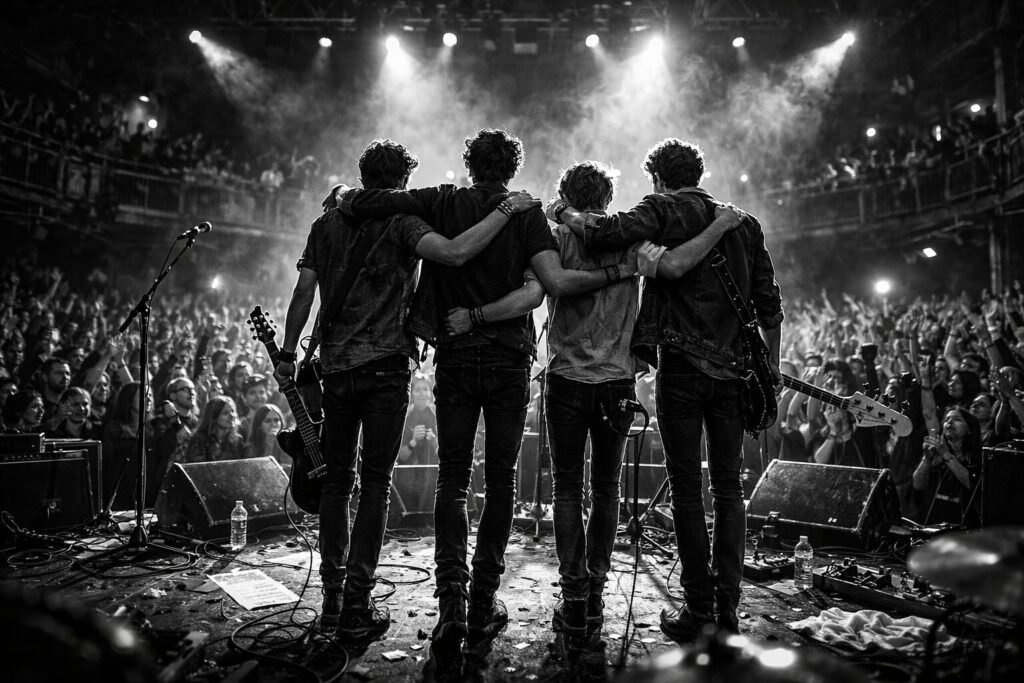
Fifteen years ago, Midnight Arcade were a band moving steadily upward through Britain’s independent music scene. The four-piece had built their audience through consistent touring and a reputation for controlled, tightly structured live performances. Their debut album, Static Between Streetlights, had established them as credible contenders within their genre, earning favourable reviews in specialist press and securing repeat regional radio play.
The record did not trouble the mainstream UK album chart, but it performed strongly within its field. Its breakout single, “Run With the Lights On”, reached Number One in the relevant genre chart — a milestone that marked the band’s most commercially significant moment. The track’s success brought increased label attention and larger support slots, while headline dates in 300- to 500-capacity venues began to sell out in advance.
By the time “Run With the Lights On” was circulating nationally, Midnight Arcade were already developing material for a second album. Band members had begun introducing new songs into their touring set, with arrangements still evolving on the road. Industry observers at the time noted a group attempting to consolidate early success without dramatically altering their sound.
That process was cut short.
The crash occurred during the return leg of a regional tour. Transport for the journey had been arranged under financial constraint. Subsequent reporting confirmed that the vehicle involved was not roadworthy. Three members of Midnight Arcade were killed. Frontman Ben Carter survived. Official investigations concluded that no moral fault lay with him.
The immediate aftermath followed a now-familiar pattern within the music industry. Tributes appeared across social media platforms and in national and regional press. Fellow musicians publicly expressed condolences. Radio stations replayed “Run With the Lights On” in tribute. Memorial events were organised in the band’s home region and in cities where they had built a following.
Within months, the band’s label released a posthumous compilation titled When the Change Runs Out. The collection featured material from Static Between Streetlights, selected live recordings, and the single that had topped their genre chart. The album charted modestly before gradually falling from listings.
For a period, Midnight Arcade were widely referenced as an example of a band whose commercial ascent had been interrupted at a pivotal moment. Coverage, while prominent, was time-limited. As other stories emerged, national attention diminished. The half-written second album was never completed or released.
Over time, the band’s name has resurfaced primarily around anniversaries or retrospective features examining that era of independent music. Fan communities remain active online, though the broader public focus has faded.
Ben Carter has not sought to maintain a public profile tied to Midnight Arcade. In the years since the crash, he has performed occasionally under his own name in smaller venues and pubs. Those performances have not included public references to the band. He has not undertaken reunion projects, anniversary tours, or curated reissues of their work.
Archival footage of Midnight Arcade’s live performances shows a physically dynamic frontman moving freely across the stage. In recent appearances, Carter performs as a wheelchair user, his mobility permanently affected by injuries sustained in the crash. He has not commented publicly on his health.
Industry figures have occasionally speculated about a formal memorial project or retrospective event. None has taken place. The band’s catalogue remains available but largely undisturbed.
In contrast to many acts whose histories are revisited through box sets or reunion shows, Midnight Arcade have not undergone a public revival. Their brief period of wider recognition remains contained within their original recordings and the single that marked their commercial peak.
Carter has declined all interview requests over the years.
Those close to him say he prefers smaller rooms now.
The music, it seems, never entirely stopped.