
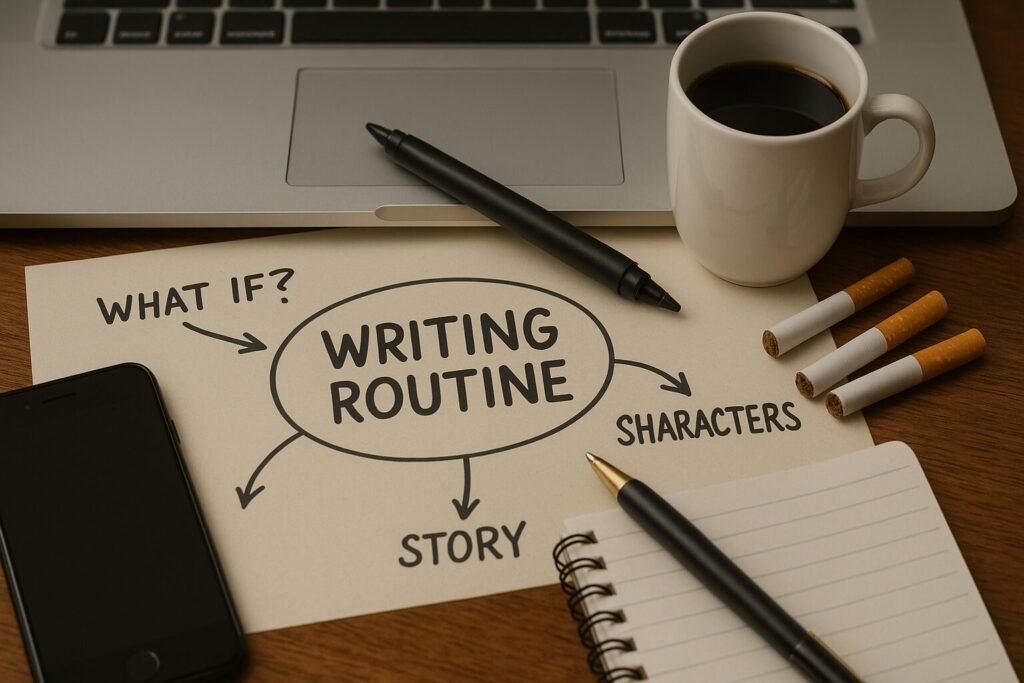
Writers love to talk about routine. Some will tell you they’re strict: early mornings, 2,000 words a day, no excuses. Others admit to chaos: inspiration comes when it comes, and good luck forcing it. I sit somewhere in the middle. I do have a routine, but I’m just as guilty of breaking it as I am of following it.
It Always Starts With “What If?”
Every single book idea of mine starts with that two-word spark: what if?
It’s deceptively simple, but it opens the door to entire worlds. What if a disavowed spy uncovered a conspiracy in his own agency? What if the Prime Minister’s daughter became a political pawn? Once I’ve got a “what if,” I’ve got a seed.
From there, I immediately look for two things: a protagonist and an antagonist. Who’s driving the story forward, and who’s standing in their way? Once I’ve got those figures in my head, I start “jotting and joshing” — throwing out half-formed ideas, lines of dialogue, fragments of scenes. They rarely arrive in order, but they give me a toolkit to play with.
Feeding the Spark
Ideas don’t grow in a vacuum. I feed mine with books, films, and shows that live in the same space as whatever I’m writing. For The Prime Minister’s Daughter, I rewatched both The Bodyguard film and the BBC series. Not because I wanted to copy them — but because they tuned my brain into the right headspace. Watching how those stories unfolded gave me ideas of my own, little nudges of inspiration that shaped the project.
Character Voices First
Before I can write a single scene, I need to hear the characters in my head. That’s why I build character profiles early. I’ll write out their histories, flaws, little quirks of speech. If I can hear their voice clearly, I know I’m on the right track.
This matters because I don’t want cardboard cut-outs. I want characters who talk back, who surprise me. Once I’ve got that, I can put them anywhere: a tense stand-off, a quiet moment of doubt, a high-stakes climax. Their voices steer the story.
Mapping the Story (My Crime-Board Method)
Next comes structure. I need to know roughly where a book begins, where the middle turns, and how it ends. I’m also thinking bigger picture: is this a standalone, or part of a series? If it’s a series, what threads need planting early?
I’m a big fan of mind maps here. Imagine the kind of crime board you see in police dramas — circles, arrows, scribbled notes, connections everywhere. That’s how my books first take shape. Messy, sprawling, but full of energy. From there, I can start tightening it into a cleaner outline.
How I Break It (and Why That’s Okay)
Now comes the truth: as much as I rely on that structure, I often end up ignoring it. I’ll tell myself I’m taking it slow, just setting the scene… and before I know it, I’ve hammered out a thousand words and I’m sat there thinking, “okay, what happens next?”
Night-time is my worst offender. I’ll be in bed, my brain buzzing, and suddenly I’m typing notes into my phone at stupid o’clock. If I don’t, the idea will be gone by morning. Other times, I break away from the desk completely. A walk. Too much coffee. Too many cigarettes (yes, it’s cliché, but it’s been my creative fuel since uni).
Weirdly enough, some of my best breakthroughs come when I stop forcing it. I’ll step away, distract myself, and then bam — the solution hits. That’s how I break writer’s block: by giving my brain permission to wander.
The Balance Between Chaos and Control
So, my routine is equal parts order and chaos. I need the structure to know where I’m going. I need the chaos to keep the story alive and surprising. It’s not neat, but it works for me.