
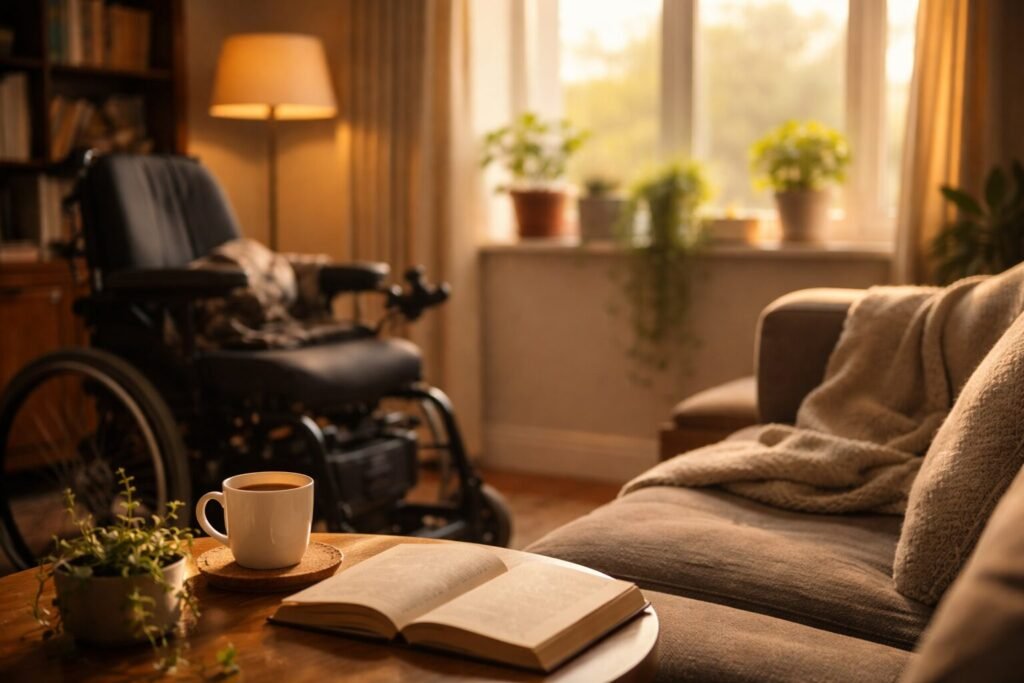
There’s a point where care and relationships stop being about checklists.
Not because anything dramatic happens.
Not because someone says the wrong thing, or the right thing, or anything at all.
It happens somewhere quieter than that.
I don’t know exactly when it started. I just know it wasn’t obvious at the time.
Care and relationships live in shared space
When Sarah first moved in, everything had edges.
There were routines. Clear ones.
Mornings followed a shape. Evenings did too.
Care happened because it needed to happen, not because it meant anything.
That’s how it’s meant to work, really.
Sarah had written — carefully, deliberately — about holding the line. About what it means to be a live-in carer without blurring yourself into someone else’s life. About boundaries, professionalism, and staying grounded inside the work.
(Holding the Line: Being a Live-In Carer)
I didn’t read it as a warning. If anything, I read it as reassurance. That the lines were there for a reason — and that we both understood them.
But shared space has a way of softening things anyway. You stop narrating your own life. You stop filling silence just to prove you’re fine. You let things sit.
Care and relationships don’t announce themselves. They grow in the gaps.
In the time between asking and being answered.
In knowing when not to speak.
In learning the sound of someone else moving through your home and not bracing for it.
When routines stop feeling clinical
At some point, the flat stopped feeling like a workplace.
Not because the care stopped being professional — it didn’t — but because the atmosphere shifted. The air felt less managed. Less watched.
Tea started appearing without being asked for.
The telly stayed on even when neither of us was watching.
Silence stopped being something to escape.
Before Sarah, I’d written about living alone — about the way quiet can press in when there’s no one else to share it with, and how independence can start to feel like isolation if you’re not careful.
(Before the Quiet Changed: Living Alone With a Disability)
That’s the thing people miss when they talk about a carer patient relationship — they imagine intensity, crisis, dependency.
What they miss is the ordinary.
Care becomes relational when nobody is trying to fix the moment.
A disability love story doesn’t start with romance
This isn’t a grand declaration.
There’s no line where things “change”.
It’s smaller than that.
It’s realising you’ve started timing your day around another person without noticing.
It’s trusting someone not to fill every quiet moment.
It’s existing alongside someone without performing gratitude or strength.
For people who live with disability, that shift matters. A lot.
So many interactions are transactional. Necessary, yes — but bounded. Measured. Temporary.
A slow burn romance disability story doesn’t rush past that reality. It sits with it.
Love and care without rescue
The most important thing — the thing I didn’t realise at first — was that nobody was trying to rescue anyone.
There was no fixing. No heroics. No rewriting of roles.
Care stayed care.
Autonomy stayed intact.
And somehow, that made room for something else to grow.
That’s where love and care start to overlap — not because one replaces the other, but because neither is being used as leverage.
Stories about disability need room to breathe
A lot of stories about disability jump straight to transformation. They skip the middle.
But the middle is where truth lives.
The middle is where you learn how to share space without obligation turning into performance. Where care stops being something you endure and starts being something you share.
Nothing had been named yet. Nothing needed to be.
But something was moving.
Love on Wheels lives in this space — the quiet moment after routine settles, when two people realise they’re no longer just passing time in the same room.
It will be released on 15 March.
If this piece resonated, share it with someone who understands that care and relationships aren’t about drama — they’re about presence.
And if you want to spend more time in this world, you’ll find everything at Cmeewrites.
Something’s beginning to take shape.
Even if nobody’s ready to say it yet.