
Having too many ideas sounds like a good problem to have.
Until it isn’t.
There’s this myth that writers struggle because they don’t have ideas. In reality, the opposite is often true. We’ve got too many. Half-formed plots. Strong character concepts. One killer scene that won’t leave us alone. A random “what if” that hits at 2am and refuses to die.
If you’re not careful, those ideas don’t inspire you — they bury you.
So this is how I handle organising writing ideas without drowning in them. This isn’t a universal method. Everyone works differently. This is just what works for me.
Step One: Every Idea Gets Its Own Folder
The first rule of organising writing ideas?
Get them out of your head immediately.
On my computer, I have a main “Books” folder. Inside that, I create a separate folder for every potential project. Even if it’s nothing more than a working title.
Let’s say the idea is called The Red Protocol (random example). That becomes its own folder straight away.
Inside that folder, everything goes:
- A one-paragraph note
- A three-page brain dump
- A character sketch
- A random line of dialogue
- A messy structure idea
- A scene that just popped into my head
It doesn’t matter how small or chaotic it is. It lives there.
Why?
Because organising writing ideas starts with containment. If every idea has a home, it stops floating around in your brain screaming for attention.
Step Two: Don’t Judge the Idea Too Early
Here’s where most people sabotage themselves.
They start evaluating the idea before it’s even formed.
“Is it commercial?”
“Is it original enough?”
“Will anyone buy it?”
“Is it too similar to X?”
Too early.
When I’m organising writing ideas, the first phase is pure capture. No judgement. No editing. Just collect the material.
Some folders stay tiny. Some explode into 20 documents within a week. That tells me something organically — without me forcing it.
Step Three: Pressure Test the Idea (Yes, With AI)
Right. Elephant in the room.
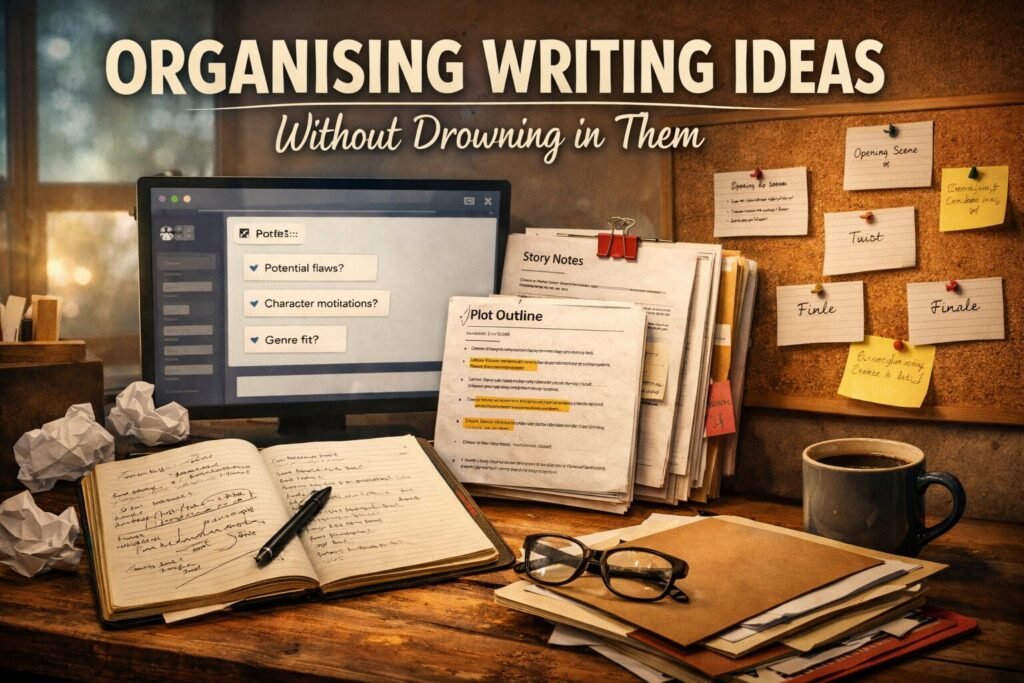
After I’ve got the raw idea captured, I’ll open a planning chat and pressure test it.
Not “Write me a 90,000 word novel.”
That’s not what this is.
I use AI like a structured whiteboard. I’ll say:
- What are the obvious weaknesses in this premise?
- Where could this fall apart in Act Two?
- Is this character motivation strong enough?
- What genre expectations would readers have?
It’s part of my process for organising writing ideas because it helps me see blind spots early.
Does that make me an “AI author”?
No.
There’s a massive difference between:
“Please write me a book about…”
and
“Help me stress-test this structure so I can build it properly.”
If you could see my project bar, you’d see all the active planning threads. Some of them will never become books. Some will. That’s the point.
Organising writing ideas doesn’t mean writing all of them. It means sorting them intelligently.
Step Four: Build a Rough Skeleton
Once an idea survives the pressure test, I move to structure.
Not a perfect outline. Just a skeleton.
- Opening situation
- Inciting incident
- Midpoint shift
- Ending direction
- Core emotional arc
If I can’t see a basic structure, the idea probably isn’t ready.
Organising writing ideas properly means identifying which ones have bones and which ones are just vibes.
Some concepts are brilliant scenes with no story engine. That’s fine. They stay in the folder until they evolve.
Step Five: Accept That Most Ideas Won’t Be Written (Yet)
This one’s important.
Not every idea deserves a manuscript.
Some ideas are training exercises.
Some are future books.
Some are stepping stones to something better.
When you’re organising writing ideas, you’re not committing to write all of them. You’re building a creative inventory.
Think of it like a vault.
When you finish a draft and think, “What next?” — you don’t panic. You open the vault.
That removes a huge amount of creative anxiety.
Why This System Stops Me Overwhelming Myself
Here’s what this approach does:
- It clears my head.
- It stops idea clutter.
- It separates excitement from execution.
- It gives every concept a fair shot.
- It stops me starting five manuscripts at once.
Organising writing ideas is really about protecting your focus.
If everything feels urgent, nothing gets finished.
But if every idea has a place — and a filter — you stay in control.
Final Thought: Structure Creates Freedom
People think structure kills creativity.
For me, it does the opposite.
Once I know my ideas are captured, organised, and stress-tested, I can relax. I’m not scared of forgetting something. I’m not worried I’ve missed a flaw.
That’s the real goal of organising writing ideas.
Clarity.
And clarity makes writing a lot more fun.
Let’s Make This Useful
How do you handle organising writing ideas?
Do you use folders? Notebooks? Voice notes? A chaotic Notes app that you promise you’ll tidy one day?
Drop a comment and tell me your system — or your struggle.
And if you want more honest, behind-the-scenes writing posts like this, head over to CMeewrites and check out The Writing Room.
Because trust me… the ideas aren’t slowing down anytime soon.