
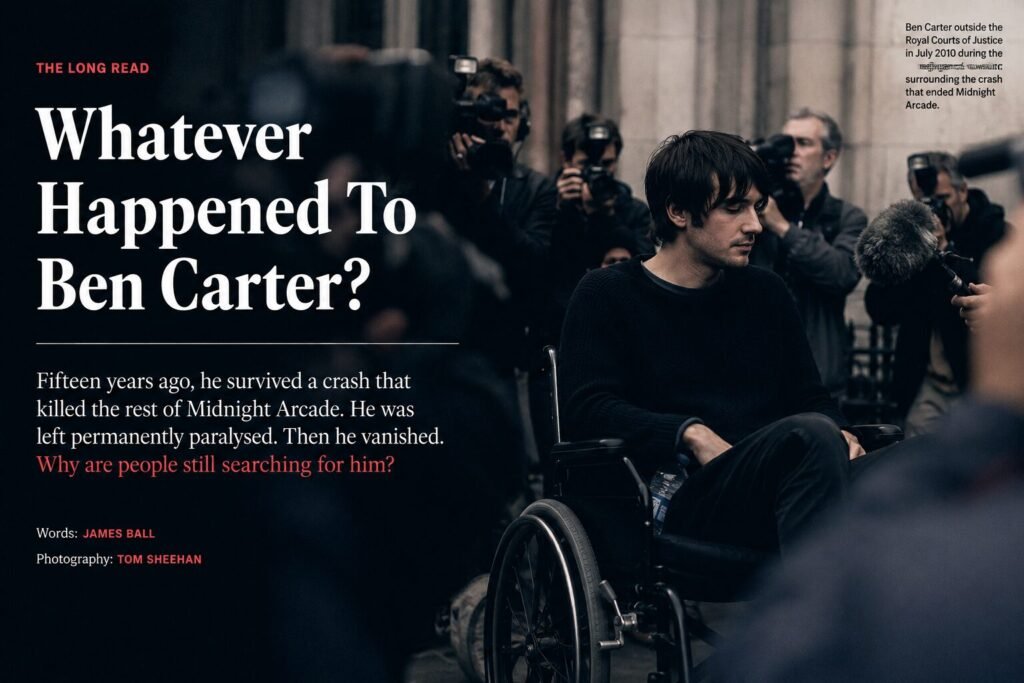
Fifteen years ago, he survived the crash that ended Midnight Arcade. It was the last time most people ever saw him.
The last confirmed public appearance of Ben Carter happened outside a courthouse.
There are photographs of it if you know where to look.
Not many. Just a handful.
In them, Carter looks older than he should. Thinner, too. The confident young frontman who had spent years commanding stages across the country has been replaced by somebody harder to read.
The crash had happened months earlier.
Ryan Hale was dead.
Marc Iqbal was dead.
Danny Brooks was dead.
Midnight Arcade were over.
Ben Carter, their frontman and sole survivor, sat in a wheelchair as photographers shouted questions he had no intention of answering.
How was he coping?
Would he ever perform again?
Did he blame anyone for what happened?
Did he blame himself?
The pictures show him looking straight ahead.
The cameras captured a man who had suddenly become one of the most talked-about figures in British music.
What they didn’t capture was that he was about to disappear.
The legal proceedings surrounding the crash would eventually conclude. Responsibility would be assigned. Damages would be awarded. Newspapers would move on to newer stories.
Ben Carter moved on too.
Just not in a way anybody expected.
There was no comeback interview.
No tell-all memoir.
No carefully managed return to the spotlight.
No attempt to transform personal tragedy into public inspiration.
He simply vanished from view.
Fifteen years later, that disappearance remains one of British music’s strangest unanswered questions.
Because while Midnight Arcade have become part of indie rock history, Ben Carter has become something else entirely.
A mystery.
And like all good mysteries, it begins with a question that should be easy to answer.
Whatever happened to him?
The Band That Never Got Its Ending
The easiest way to misunderstand Midnight Arcade is to turn them into legends.
History does this all the time.
Artists who die young become larger than life. Potential becomes certainty. Promise becomes destiny.
Every unfinished career becomes a masterpiece waiting to happen.
The truth is usually more complicated.
Midnight Arcade were not the biggest band in Britain.
They were not selling out arenas.
They were not gracing the covers of every music magazine in the country.
What they were was ascending.
Their debut album, Static Between Streetlights, had established them as one of the more exciting names emerging from the British indie scene. Their breakout single, Run With the Lights On, reached number one within its genre chart. Industry attention was growing. Crowds were getting larger. The second album was already being written. The trajectory was unmistakably upward.
People sensed it.
Fans sensed it.
The industry sensed it.
Most importantly, the band themselves sensed it.
Talk to people who followed Midnight Arcade during those final months and one phrase comes up repeatedly.
“They were on the verge.”
Nobody can quite define what that verge was.
A major breakthrough.
Festival headlines.
National radio.
Something.
But the feeling was there.
The sense that the next chapter was about to begin.
Instead, the story stopped.
And when stories stop unexpectedly, people spend years imagining the ending they never received.
Why Ben Became the Story
What’s interesting is that people don’t spend fifteen years searching for Ryan Hale.
Or Marc Iqbal.
Or Danny Brooks.
They miss them.
They celebrate them.
They wonder what music they might have made.
But they don’t search for them.
They search for Ben.
Partly because he survived.
Partly because survival carries its own mythology.
But mostly because he remained.
The others became memory.
Ben became a question mark.
He was the one person left alive who knew what Midnight Arcade had been like behind closed doors.
The one person who knew what the unfinished second album sounded like.
The one person who knew what happened after the hospital corridors emptied and the cameras disappeared.
And then he chose not to tell anyone.
That silence created a vacuum.
Over the next fifteen years, fans filled it with theories.
Some believed the physical consequences of the crash made public life impossible.
Court records confirmed that Carter had suffered life-changing injuries and had been left permanently paralysed. For many observers, that fact alone seemed explanation enough. A young frontman whose entire identity had revolved around movement, performance and momentum suddenly found himself facing a radically different future.
Others focused on the psychological impact.
Online discussions frequently speculate about survivor’s guilt, depression and the emotional burden of being the only member of Midnight Arcade left alive.
Those theories are understandable.
They are also impossible to verify.
Because Ben Carter never gave anybody enough information to know.
And that’s where every road eventually leads.
To silence.