
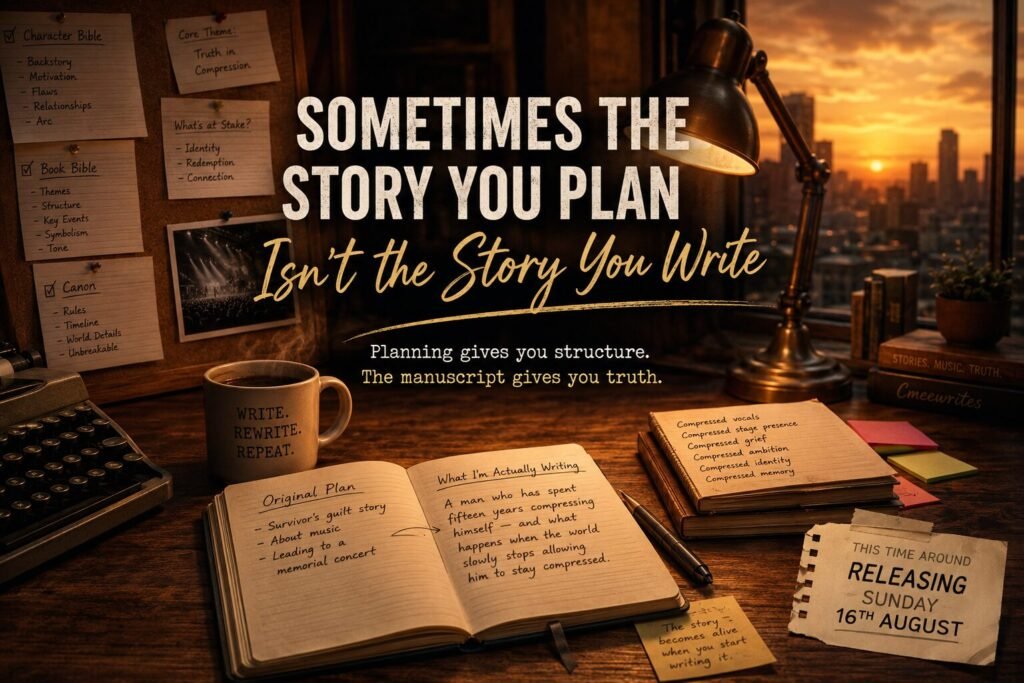
’m a planner when it comes to writing.
Not the “couple of notes on my phone and hope for the best” kind either.
I mean proper planning.
Character bibles.
Book bibles.
Canon documents.
Timelines.
Rules that cannot be broken halfway through the manuscript.
When it comes to writing a story vs planning a story, I’ve always leaned heavily towards planning first. I genuinely believe preparation matters because the stronger your foundations are, the easier it becomes to build a believable world and emotionally consistent characters.
But there’s one thing I’ve realised over the last few years.
Sometimes writing a story changes the story you originally planned.
And honestly, I think that’s where the real magic starts happening.
Writing a Story vs Planning a Story
Planning a novel gives you structure.
It gives you direction.
It stops the story collapsing into chaos halfway through Chapter Twelve when you suddenly realise your timeline makes absolutely no sense anymore.
But writing the actual manuscript is completely different.
Because that’s when the story finally becomes alive.
That’s when characters stop feeling theoretical and start behaving like real people.
And sometimes, once you start writing a story properly, you realise the novel is actually about something deeper than the original concept you planned.
That’s exactly what’s happening with This Time Around while I’m writing it.
The Story I Planned Isn’t Quite the Story I’m Writing
Fundamentally, This Time Around is still the same novel I planned at the start.
The structure is still there.
The emotional core is still there.
The memorial concert storyline is still there.
But the deeper I get into the manuscript, the more I can feel subtle changes happening underneath the surface.
Originally, I thought I was writing:
- a survivor’s guilt story
- about music
- leading towards a memorial concert
And technically, all of that is still true.
But what I’m actually writing now feels much more specific emotionally.
Because the novel has slowly clarified what it’s really about.
At its heart, This Time Around has become a story about a man who has spent fifteen years compressing himself emotionally, physically, socially and artistically — and what happens when the world slowly stops allowing him to stay compressed.
That became the real through-line.
Not because I consciously planned it.
Because writing the manuscript revealed it.
Sometimes the Manuscript Knows More Than the Outline
This is the strange thing about writing fiction.
You can outline themes all day long.
You can plan emotional arcs.
You can create spreadsheets, scene breakdowns and character notes.
But sometimes the actual writing process exposes truths that weren’t fully visible when the story only existed as an outline.
With This Time Around, the idea of compression started appearing everywhere once I noticed it.
Compressed vocals.
Compressed stage presence.
Compressed grief.
Compressed ambition.
Compressed identity.
Compressed memory.
Even Ben’s physical presence in rooms feels smaller than it should.
Like he’s spent fifteen years trying not to take up space anymore.
None of that existed clearly in my original planning documents.
That emerged naturally while writing the novel.
And honestly, I think that’s the biggest difference between writing a story vs planning a story.
Planning builds the skeleton.
Writing creates the soul.
Why Planning Still Matters
That doesn’t mean planning suddenly becomes pointless.
Far from it.
Without the planning side, this novel would probably collapse under its own emotional weight.
The structure matters massively.
The continuity matters.
The pacing matters.
Especially in a character-driven story carrying this much grief and emotional history.
But I’ve stopped looking at planning as building a prison for the novel.
Now I see it more like building the stage.
The real performance still happens afterwards.
And sometimes that performance changes the meaning of the story completely.
The Best Stories Sometimes Surprise the Writer Too
I think the best writing happens when the story starts pushing back slightly against your original assumptions.
Not enough to destroy the structure.
But enough to deepen it.
Enough to reveal something more honest underneath.
That’s where This Time Around feels different to me now.
It’s still fundamentally the same novel I planned.
But emotionally, it has become something much more human than I originally realised.
And honestly?
That’s probably the point where a manuscript stops feeling mechanical and starts genuinely breathing.
Join the Conversation
Do you prefer strict planning when writing fiction, or do you discover the story while you’re writing it?
I’d genuinely love to hear how other writers approach the balance between writing a story vs planning a story.
Leave a comment below and join the discussion.
And if you want more behind-the-scenes insight into novels, storytelling, writing struggles and the reality of building books from scratch, head over to CMeewrites and explore the rest of the site.