
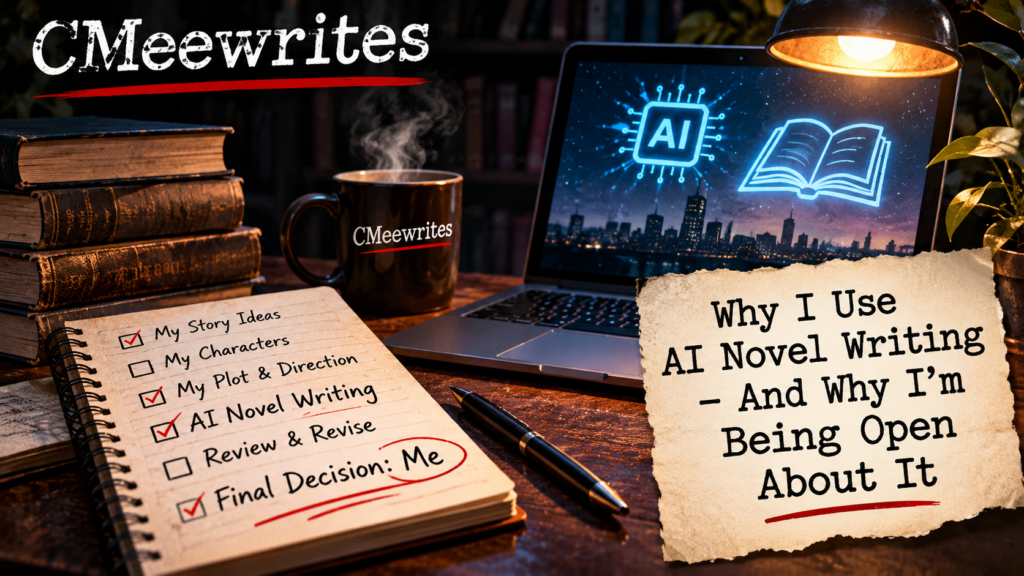
There’s something I’ve been meaning to write about for quite a while, and I’ve finally decided it’s time to put it out there.
Artificial intelligence.
More specifically, AI novel writing, how I use it to produce my books, and why I’ve got absolutely no intention of hiding the fact that it’s part of my creative process.
Now, I know what some people are probably thinking.
Oh, here we go. Another article about AI.
And I get it.
Artificial intelligence seems to be everywhere at the moment. You can’t go five minutes without somebody telling you it’s going to revolutionise the world or destroy everything we know.
The publishing industry is no different.
Some authors embrace AI. Others absolutely hate it. And there are plenty of readers who have very strong opinions about whether artificial intelligence should be involved in writing fiction.
I’m not here to tell anybody what they should think.
But I do want to explain something about my own books.
Because the truth is, without AI, CMeewrites probably wouldn’t exist.
And considering how much work I’ve put into building it, I think that’s worth talking about.
Why I’m Being Open About AI Novel Writing
Recently, I received an email from Amazon concerning its AI disclosure policy.
That prompted me to take another look at how I’d classified the use of artificial intelligence in my published novels.
Previously, I’d considered my work AI-assisted.
And from my point of view, that made perfect sense.
I come up with the stories. I develop the characters, plan the plots, decide what happens and make the final creative decisions.
However, Amazon KDP makes a distinction between AI-assisted and AI-generated content.
Under its definitions, when AI produces text that becomes part of a published manuscript, that text is considered AI-generated, even if the author subsequently edits, revises and approves it.
And because AI helps produce substantial portions of the prose in my novels, AI-generated text is the appropriate disclosure for my books.
That doesn’t mean Amazon is saying a computer invented my stories.
It’s describing how the content was produced, not necessarily who conceived the ideas or made the creative decisions.
I’m also not suggesting that Amazon has suddenly introduced a completely new policy. Receiving the email simply encouraged me to look more closely at how the terminology applies to my writing process.
And that got me thinking.
I’ve never wanted readers to feel that I’m deceiving them.
I’m proud of my books, and I’m proud of the work that goes into them.
So rather than leaving people to make assumptions about what AI-generated actually means, I thought I’d explain the process myself.
After all, if I’m going to put my name on the cover of a novel, I should be prepared to explain how that novel was written.
Why CMeewrites Wouldn’t Exist Without AI
Here’s where things become a little more personal.
I have cerebral palsy, dyslexia and other disabilities that make conventional writing considerably more difficult than it is for most people.
And when I say difficult, I don’t mean that typing takes me an extra ten minutes.
Writing can be physically painful, exhausting and incredibly time-consuming.
I’ve wanted to become an author for years.
Long before ChatGPT existed. Long before AI could produce anything resembling decent fictional prose. Long before artificial intelligence became something everybody seemed to have an opinion about.
The ambition was always there.
The problem was finding a practical way to do it.
There’s a massive difference between having an idea for a novel and physically producing 90,000 words.
And that’s before you start thinking about editing, rewriting, proofreading, formatting and everything else involved in getting a book ready for publication.
Yes, I use dictation software.
And yes, it helps.
But dictation doesn’t magically remove all the difficulties associated with producing a complete manuscript.
You still have to organise everything, correct mistakes, restructure sentences, revise chapters and somehow turn tens of thousands of words into a coherent story.
When you have disabilities that affect both the physical process of writing and the way you work with written language, that becomes an enormous undertaking.
For years, I had stories in my head that I wanted to tell.
But wanting to write a novel and being physically able to produce one are two very different things.
It was only when artificial intelligence developed to the point where it could genuinely help produce prose, rather than simply suggest a few ideas, that becoming a published novelist started to feel achievable.
Suddenly, I had a practical way of doing something I’d wanted to do for years.
Not an easy way.
Not a magical shortcut.
But a way.
And that’s the important distinction.
AI didn’t give me the ambition to become a writer. It gave me a practical way to pursue an ambition I’d already had for years.
Without these tools, writing a single novel could potentially take me years.
With them, I can spend far more of my limited time and energy developing stories instead of struggling with the physical process of getting words onto a page.
And before anybody starts with the inspirational speeches, I’m not looking for a medal because I’m disabled.
I don’t want to be somebody’s heartwarming example of overcoming adversity.
I just want to write books.
Preferably quite a few of them.
And AI novel writing tools make that possible.
How I Actually Use AI to Write My Novels
Right, let’s get into the part that people are probably most interested in.
How much artificial intelligence do I actually use?
Quite a lot.
There you go. No dancing around the subject.
AI is involved in much of my writing and publishing process, from developing the earliest story ideas to preparing a finished book for publication.
Sometimes, that process begins at some ridiculous hour of the morning.
My brain has a habit of coming up with ideas when most sensible people are asleep.
I’ll suddenly think of a character, a plot twist or an entire storyline, and I’ll start exploring whether it could work.
Sometimes those ideas are genuinely promising.
Other times, they’re the sort of thing that sounds brilliant at three in the morning and considerably less impressive when you revisit it later.
That’s where AI becomes useful.
I use it to pressure-test ideas.
Does the premise make sense?
Would the characters realistically behave that way?
Is there enough substance to turn the idea into a full-length novel?
And, perhaps most importantly, have I accidentally created a plot hole large enough to drive a bus through?
Once I’m happy that an idea has potential, I start developing it properly.
That means working through the overall plot, creating characters, establishing their backgrounds and motivations, and deciding how the story should develop.
Then I begin planning the chapters.
And within those chapters, I work through the individual scenes.
This is where AI novel writing becomes particularly important to my process.
I don’t simply tell AI to write an entire book and then publish whatever comes back.
I work through the story scene by scene.
I decide what needs to happen, which characters are involved, what they know, how they should behave and what emotional consequences should follow.
I think about how each scene fits into the wider story.
What needs to change?
What does the reader need to understand?
What information should remain hidden?
And how will the decisions made in this chapter affect something that happens later?
Once those things are established, AI helps turn my instructions and creative decisions into written prose.
And I want to be completely clear about something.
Substantial portions of the actual prose in my published novels are initially generated by artificial intelligence.
I’m not going to pretend that AI merely checks my spelling or suggests the occasional alternative word.
Its contribution goes considerably further than that.
But generating the initial prose is only part of the process.
I review what it produces, challenge things that don’t work, revise passages and decide whether the finished scene actually tells the story I intended.
Sometimes the result is close to what I wanted.
Sometimes it needs considerable work.
And sometimes it’s so far off the mark that I genuinely wonder whether the AI has been paying attention to anything we’ve discussed.
Beyond the manuscripts themselves, I also use AI to help with editing, continuity checking, website content, marketing, search engine optimisation and publishing administration.
Running an independent author brand involves considerably more than just writing novels.
There’s a website to maintain, books to promote, descriptions to prepare and all the other jobs that come with being your own publisher.
If technology can reduce some of that workload, I’m going to use it.
Because I’d rather spend my energy creating stories than fighting with a keyboard for hours.
AI Novel Writing Doesn’t Mean Letting a Computer Take Over
One of the biggest misconceptions about AI novel writing is that somebody can simply type a sentence into a computer and receive a finished, publishable novel.
Something along the lines of:
Write me a political thriller about the Prime Minister’s daughter.
Then sit back, have a cup of tea and wait for the bestseller to appear.
If only it were that simple.
The reality is considerably messier.
And anybody familiar with how I work will know that I don’t hesitate to tell AI when it’s made a complete mess of something.
I’ve rejected entire scenes because a character behaved in a way that made absolutely no sense.
I’ve thrown out passages because they contradicted something established several chapters earlier.
I’ve challenged dialogue, changed the direction of scenes and insisted on rewriting sections because the emotional consequences weren’t believable.
And I’ve abandoned entire manuscripts when I wasn’t satisfied with where the story was going.
That’s hardly the behaviour of somebody who simply presses a button and accepts whatever appears on the screen.
I regularly argue with AI.
Sometimes quite extensively.
I’ll spend ages explaining exactly what I want from a scene, only for the AI to produce something that completely misses the point.
At which stage, let’s just say my response isn’t always suitable for polite company.
Artificial intelligence has probably been called a few things during my writing sessions that its developers wouldn’t particularly appreciate.
But there’s a serious point underneath the humour.
Producing words quickly isn’t the same thing as telling a good story.
You can generate thousands of words in a relatively short period.
That doesn’t automatically mean those words form a decent novel.
Characters still need believable motivations.
Relationships need to develop naturally.
Plot twists need to make sense.
Decisions need consequences.
And an ending needs to feel like the conclusion of the story you’ve been telling, rather than something you’ve suddenly invented because you’ve reached the final chapter.
Those are the things I spend my time thinking about.
And they’re the things I’m constantly checking as I work through a manuscript.
If something doesn’t fit the story, it goes.
If a character behaves inconsistently, I challenge it.
If the plot starts heading somewhere I don’t want it to go, I change direction.
AI might help produce the words, but it doesn’t get to decide what my novel becomes.
I do.
Where I Draw the Line Between AI and Authorship
My approach to AI novel writing comes down to one fairly straightforward principle.
AI is a tool. I’m the author.
Now, that doesn’t mean I’m claiming to have manually written every sentence.
I haven’t.
And I think it would be dishonest to suggest otherwise.
AI contributes directly to the wording of my novels.
I’ve explained that openly, and I’m perfectly comfortable acknowledging it.
But I don’t believe authorship is determined entirely by who physically types the words.
For me, authorship involves the ideas, the creative vision, the characters, the decisions and the responsibility for the finished work.
I’m the one who decides which stories I want to tell.
I’m the one who develops the characters and determines how they change throughout the novel.
I’m the one who decides what happens to them, which scenes belong in the manuscript and whether the ending works.
AI can suggest alternatives.
It can identify problems.
It can offer different ways of approaching a scene.
And it can help physically construct the prose.
But those suggestions don’t automatically become part of the book.
I decide what stays.
I decide what changes.
And I decide when a manuscript is ready to publish.
That also means accepting responsibility when something doesn’t work.
If a character is poorly developed, that’s ultimately my responsibility.
If a plot twist falls flat, that’s on me.
And if somebody finishes one of my books and thinks the ending is rubbish, they can blame me.
Although I’d obviously prefer they didn’t.
The point is that I don’t get to take credit for everything readers enjoy while blaming the computer for everything they don’t.
My name is on the cover.
The responsibility comes with it.
Is AI Novel Writing Really That Different From Getting Help From Another Person?
There’s something from my university days that I think is particularly relevant to this conversation.
When I was studying for my degree, I had an academic support worker who helped me write my essays.
Because of my disabilities, producing written work wasn’t always straightforward.
I would dictate what I wanted to say.
Sometimes it wouldn’t come out in perfect English. Sometimes the sentences needed restructuring, or what I was trying to explain needed organising into proper paragraphs.
My support worker helped me do that.
But here’s the question.
Does that mean I didn’t write my university essays?
Of course it doesn’t.
I still had to do the research.
I still needed the knowledge.
I still had to understand the subject, develop my arguments and know what I wanted to say.
My support worker wasn’t doing my degree for me. She was helping me communicate what I already knew.
And nobody should confuse those two things.
Now, fast-forward to my life as a novelist.
In many ways, I’m doing something remarkably similar.
I know the story I want to tell. I develop the characters, work through the plot and decide what needs to happen in each scene.
But instead of dictating my thoughts to an academic support worker who helps turn them into properly structured paragraphs, I’m using AI to help turn those thoughts into fictional prose.
In that respect, I’ve replaced a person with a computer.
Now, before somebody jumps down my throat, I’m not suggesting the two arrangements are identical.
AI can generate substantial passages of prose, suggest alternatives and contribute wording that goes beyond simply tidying up something I’ve dictated.
And there are legitimate ethical questions surrounding that technology which didn’t necessarily apply to my university support worker.
I understand that.
But the underlying principle is something I’ve experienced firsthand.
Receiving assistance with the physical production of written work doesn’t automatically mean somebody else is responsible for the ideas behind it.
My university essays still required my knowledge, research and understanding.
My novels still require my imagination, planning, characters, plot development and creative decisions.
If I don’t understand where a story is going, AI isn’t going to magically turn it into the novel I want to write.
If I haven’t developed the characters properly, the prose might sound lovely, but the story will still have problems.
And if I don’t recognise when something doesn’t make sense, those problems will end up in the finished book.
That’s why I don’t see AI novel writing as surrendering authorship.
I see it as another way of making writing accessible to me.
I needed assistance producing written work when I was at university.
I need assistance producing written work now.
The technology has changed, and the type of assistance isn’t exactly the same.
But needing help to put my thoughts into words doesn’t mean those thoughts aren’t mine.
And it’s worth remembering that traditional publishing has always involved different kinds of collaboration.
Authors work with editors, proofreaders, researchers and sometimes ghostwriters.
A ghostwriter might turn somebody else’s ideas or experiences into a manuscript. An editor might recommend substantial changes to the structure or wording of a book.
Those arrangements aren’t identical to using AI. Human professionals bring their own judgement, experience and creativity, and generative AI raises different ethical questions.
But the existence of those working relationships does raise an interesting point.
Getting help with producing a manuscript doesn’t automatically mean surrendering responsibility for the finished work.
And for me, that distinction matters.
What About Readers Who Disagree With AI-Generated Novels?
Here’s something else I want to make absolutely clear.
I don’t expect everybody to agree with me.
There are readers who don’t want to buy books containing AI-generated prose.
There are authors who believe artificial intelligence has no place in creative writing.
And there are people who have serious concerns about how AI systems are trained and what their increasing use could mean for writers, artists and other creative professionals.
Those are legitimate concerns.
I’m not going to dismiss them simply because AI happens to be useful to me.
Nor am I going to pretend that my disabilities somehow settle every ethical argument surrounding the technology.
They don’t.
If somebody reads this article and decides they no longer want to buy my novels, that’s their decision.
Would I be disappointed?
Of course.
I’m an independent author. Every reader matters.
But I’d rather somebody make an informed decision about my books than buy one under a misunderstanding about how they were produced.
And I certainly don’t want anybody to feel that I’ve deliberately concealed something.
All I would ask is that people consider the accessibility side of AI novel writing as well.
Because when we talk about artificial intelligence in publishing, we sometimes forget that not everybody starts from the same position.
For some writers, AI might be about convenience.
For others, it might be about producing content more quickly.
But for some disabled authors, it’s about whether writing a novel is realistically achievable in the first place.
That’s a very different conversation.
And it’s one I think deserves to be part of the wider debate.
I’m not asking anybody to abandon their principles.
I’m not asking people to ignore concerns about artificial intelligence.
I’m simply asking them to understand how and why I use it before deciding what they think of my work.
You might still disagree with me afterwards.
That’s fine.
At least we’ll be having the conversation with a clearer understanding of what my writing process actually involves.
The Stories Are Still Mine
When I look at the novels I’ve published through CMeewrites, I don’t see stories that a computer decided to tell.
I see characters I’ve spent countless hours developing.
Plots I’ve argued over, rewritten and occasionally wanted to throw out of the nearest window.
Scenes I’ve worked through repeatedly because they weren’t doing what I needed them to do.
And finished books that represent an enormous amount of creative work.
Would those novels exist in their current form without AI?
No.
I’ve been completely open about that.
But would they exist without me coming up with the ideas, developing the characters, making the decisions and putting in the work to turn those ideas into complete stories?
No.
And that’s the distinction I want readers to understand.
I didn’t suddenly decide to become an author because artificial intelligence appeared.
I’ve wanted to write novels for years.
Technology finally gave me a practical way to do it.
And now that I can, I intend to keep writing them.
Some readers will agree with my approach.
Others won’t.
That’s fine.
I don’t expect universal approval, and I’m certainly not interested in pretending that AI plays a smaller role in my writing than it actually does.
What matters to me is being honest about the process and standing behind the books I publish.
The successes are mine.
The mistakes are mine.
And the responsibility is mine.
AI helps me put the words on the page. But the stories, the decisions and the responsibility for every book with my name on the cover are mine.
And I’m perfectly comfortable putting my name to that.
Let’s Talk About It – I’d Genuinely Like Your Opinion
I’ve explained why AI novel writing is such an important part of my life, but now I’d genuinely like to know what you think.
Does knowing how I write my novels change your opinion of them?
Do you see AI as a useful accessibility tool, or do you believe it has no place in creative writing?
Perhaps you’re somewhere in the middle.
Whatever your opinion, I’d be interested to hear it.
Leave a comment below and tell me what you think. You don’t have to agree with me. In fact, a decent conversation is usually far more interesting when everybody isn’t saying exactly the same thing.
And if you think this article might help somebody understand a different perspective on AI and creative writing, please share it.
You can also explore my published novels, find out what I’m working on next and learn more about my writing journey at CMeewrites.
The way I write might be unconventional. But the stories are still worth telling.