
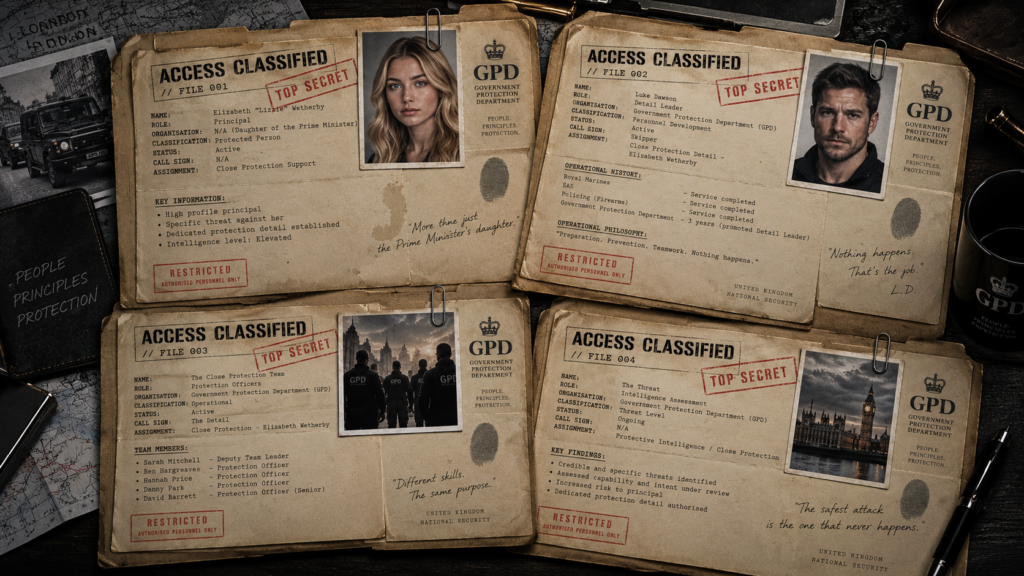
SUBJECT: THE DETAIL
CLASSIFICATION: OPERATIONAL DEVELOPMENT
Why Close Protection Is a Team Sport
There is a version of The Prime Minister’s Daughter that would have been much easier to write.
Luke Dawson protects Lizzie Wetherby.
That’s it.
He drives the car. He checks the building. He spots the suspicious bloke standing across the road. He works out where the threat is coming from. He pulls Lizzie out of danger. Then, when everything inevitably goes to shit, he draws his weapon and deals with the attackers while everybody else stands around being spectacularly useless.
We’ve all seen that version of the bodyguard story.
I didn’t want to write it.
One of the things I decided very early when developing The Prime Minister’s Daughter was that if I wanted the protection side of the story to feel remotely believable, Luke couldn’t be a one-man army.
He needed a close protection team.
More importantly, that team needed to feel like an actual team.
Luke Dawson Doesn’t Protect Lizzie Alone
Luke is the central protagonist of the trilogy and, at the beginning of The Prime Minister’s Daughter, he has just been promoted to Detail Leader and given responsibility for protecting the Prime Minister’s twenty-year-old daughter.
That’s a massive moment in his career.
But promotion doesn’t suddenly make Luke better than everybody around him.
It makes him responsible for them.
That’s an important distinction.
When Luke is offered the job, his attitude towards command is established almost immediately. If one of his officers makes a mistake, that’s his responsibility. If the protection plan fails, that’s his responsibility. If something happens to Lizzie, he considers that his failure.
That’s what becoming Detail Leader means to him.
He isn’t being handed five assistants.
He’s being handed a close protection team consisting of experienced, armed professionals whose individual decisions could determine whether Lizzie Wetherby gets home safely.
And Luke trusts them to make those decisions.
Meet the Detail
There are five officers working alongside Luke: Sarah, Ben, Hannah, Danny and Barrett.
I didn’t want them to be names that occasionally appeared over the radio.
Each of them needed a reason to be there.
Sarah Mitchell is Luke’s deputy and probably the person whose judgement he trusts most naturally. She’s experienced, dependable and calm. Sarah doesn’t need Luke checking every decision she makes because the whole point of having a capable deputy is that Luke knows she can do the job.
She’s also the stabilising presence within the team.
Sarah isn’t trying to prove she’s the toughest person in the room. She doesn’t need to. Her experience has taught her that good close protection is based on preparation, communication and trust rather than bravado.
Then there’s Ben Hargreaves.
Ben has the advantage — or possibly disadvantage — of having known Luke for years.
Luke might have been promoted, but Ben hasn’t suddenly decided that means he has to start treating his mate like visiting royalty.
He’ll take the piss.
He’ll tell Luke to fuck off.
He’ll push his luck.
But the important thing for me was making sure Ben never became comic relief.
When the atmosphere changes, Ben changes with it.
He’s an experienced protection officer. The jokes disappear, the training takes over and Luke knows he can rely on him.
Hannah Price is different again.
Hannah is steady.
Capable.
Professional.
And I think characters like Hannah are actually important when you’re trying to make a fictional team believable, because not everybody in a workplace is the loudest personality in the room.
Sometimes you need somebody who simply does their bloody job.
Hannah doesn’t need a gimmick. She doesn’t need to constantly challenge Luke, crack jokes or create drama. Her value to the close protection team is precisely that Luke knows what he’s getting from her.
Then we have Danny Park.
The Rookie.
Danny is young, talented, physically capable and very good with a weapon.
Unfortunately, Danny is also fully aware that he’s young, talented, physically capable and very good with a weapon.
That’s where Luke comes in.
Luke can see the officer Danny could become. The raw ability is already there. What he lacks is experience and, occasionally, patience.
As Luke sees it early in the novel, Danny’s instinct is to get there first and worry afterwards about whether he should have gone there at all.
One of the lessons Luke has to teach him is something that doesn’t sound particularly exciting in a thriller:
Sometimes the cleverest thing an armed protection officer can do is absolutely nothing.
And finally, there’s David Barrett.
Grandad.
Barrett is the veteran of the team.
He’s older, highly experienced and has spent years doing this job. In fact, when Luke is first told Barrett will be serving under him, his immediate reaction is that Grandad isn’t going to enjoy taking orders from somebody younger.
But Luke also knows exactly what Barrett brings to the detail: experience.
At the beginning of the story, that’s what matters.
Five officers.
Five different personalities.
Five different levels and types of experience.
And one newly promoted Detail Leader who is accountable for all of them.
The Convoy That Told Me What the Team Needed to Be
One of my favourite early examples comes in Chapter Two.
And almost nothing happens.
The team are travelling towards Whitehall in two vehicles.
Sarah communicates over the radio.
Ben adjusts the speed of the lead vehicle without Luke having to tell him.
Barrett spots a cyclist approaching the convoy.
The acknowledgements come back.
Everybody knows where everybody else is.
Nobody gives a dramatic speech.
Nobody needs Luke to explain their own job to them.
That’s exactly how I wanted the close protection team to feel.
Competent people doing something they’ve done hundreds of times before.
But there’s another layer underneath it.
They’re mates.
Ben can tell Luke to fuck off. Danny can laugh at him.
And Luke suddenly has to process the fact that the relationship has changed.
Yesterday, Ben was his mate taking the piss.
Today, Luke is responsible for the bastard.
I love that distinction because it gets to the heart of what Luke’s promotion actually means.
He hasn’t magically become more capable than Sarah, Ben, Hannah, Danny or Barrett overnight.
He’s become accountable for what all six of them do.
Close Protection Should Be Boring
This might sound strange considering I’ve written a political thriller involving threats against the Prime Minister’s daughter, but one of the ideas sitting underneath the whole book is that successful close protection should often be boring.
Nobody gets shot.
Nobody dives through a window.
Nobody dramatically throws themselves over the principal.
Nothing explodes.
Everybody goes home.
That’s success.
If intelligence identifies a problem early enough, the route changes.
If the team doesn’t like a venue, the movement can be altered.
If something doesn’t feel right, they can delay.
If a threat develops while they’re moving, getting Lizzie away from it is considerably more important than standing around trying to win a gunfight.
Luke’s philosophy is deliberately simple:
Nothing happens. That’s the job.
That’s why the quieter protection scenes mattered just as much to me as the action.
They establish what normal looks like.
And once you’ve shown the reader what a professional protection operation looks like when everything works, it means something when normality suddenly disappears.
They’re Not Six Action Heroes
There was another trap I wanted to avoid.
Once I’d decided Luke couldn’t be Superman, the answer wasn’t to create six Supermen.
A believable close protection team works because different people are doing different things.
Somebody is watching the principal.
Somebody is driving.
Somebody is communicating.
Somebody is looking beyond the immediate bubble.
Somebody notices the cyclist.
Somebody has already thought about where they’re going if the planned route suddenly becomes unusable.
And all of that is happening while the person they’re protecting might be completely unaware of most of it.
That’s another part of the job I find fascinating.
Lizzie doesn’t necessarily see five separate officers making dozens of small decisions around her.
She just gets into a car and arrives somewhere.
If they’ve done everything properly, that’s probably all she should notice.
Why They Had to Become Characters
From a writing point of view, there was another reason Sarah, Ben, Hannah, Danny and Barrett couldn’t remain anonymous officers on a rota.
Trust.
I’m asking the reader to believe that Luke Dawson trusts these people with Lizzie Wetherby’s life.
That’s a massive thing to ask the reader to accept if they don’t know who those people are.
So the relationships matter.
Luke knows Sarah’s judgement.
He knows Hannah’s composure.
He knows Ben can joke about almost anything without allowing it to interfere with the job.
He knows Barrett has more protection experience than most officers around them.
And he knows Danny has enormous potential if somebody can persuade him that ability and experience aren’t the same thing. Those assessments are already running through Luke’s head when the team is first put together.
Those aren’t just character descriptions.
They’re reasons Luke trusts them.
And, hopefully, reasons the reader eventually does too.
Taking the Piss Until the Radio Changes
I think this might be my favourite part of writing the detail.
They’re professionals.
They’re also people who spend an enormous amount of time together.
That means there is banter. There are nicknames. There are old stories. There are people who know exactly which button to press when they want to annoy somebody.
Sarah is Mum.
Danny is Rookie.
Barrett is Grandad.
Luke becomes Skipper.
But none of that means they aren’t taking the job seriously.
Quite the opposite.
The contrast is what makes them feel real to me.
They can be sitting in a vehicle taking the piss out of each other one second.
Then the radio changes tone.
And everybody shuts up.
The professional switch gets flicked.
That was important because I didn’t want it to feel as though five characters had been assembled around Luke because the plot required five bodyguards.
I wanted it to feel like these people had worked together before we met them.
They know each other’s habits.
They know each other’s strengths.
They know who needs telling to shut up.
And when something goes wrong, they know what the person beside them is going to do.
Luke Leads the Team. He Isn’t the Team.
Luke Dawson is unquestionably at the centre of The Prime Minister’s Daughter.
But making him competent never required making everybody else incompetent.
In fact, I think doing that would have made Luke less convincing.
Good leadership isn’t doing everybody else’s job for them.
It’s building a team where you don’t have to.
Luke’s promotion to Detail Leader gives him authority, but the more interesting thing it gives him is responsibility.
Sarah, Ben, Hannah, Danny and Barrett are armed professionals capable of making their own decisions.
Luke has to trust them.
And they have to trust him.
Because when six people are responsible for keeping one person alive, there might eventually be moments when there simply isn’t time to ask the boss what to do.
The decision has to have already been made.
The training has to take over.
The team has to work.
And on a good day?
Nothing happens.
That’s the job.
ACCESS MORE CLASSIFIED FILES
How important is realism to you in a thriller? Do you prefer the lone bodyguard who does absolutely everything, or a protection team where every officer has a role?
Share the article, leave a comment and let me know what you think.
And if you want to find out more about The Prime Minister’s Daughter, Luke Dawson, the Government Protection Department and the other operations I’ve been quietly declassifying, head over to the ACCESS CLASSIFIED section of CMeewrites®:
ACCESS CLASSIFIED will return.