
Sometimes, I wonder where writers get their ideas from.
I’ve had ideas come from conversations, things I’ve watched on television, something I’ve read or even a random thought that popped into my head when I was supposed to be doing something completely different.
But I think I’ve managed to find one of the more ridiculous sources of inspiration for a story.
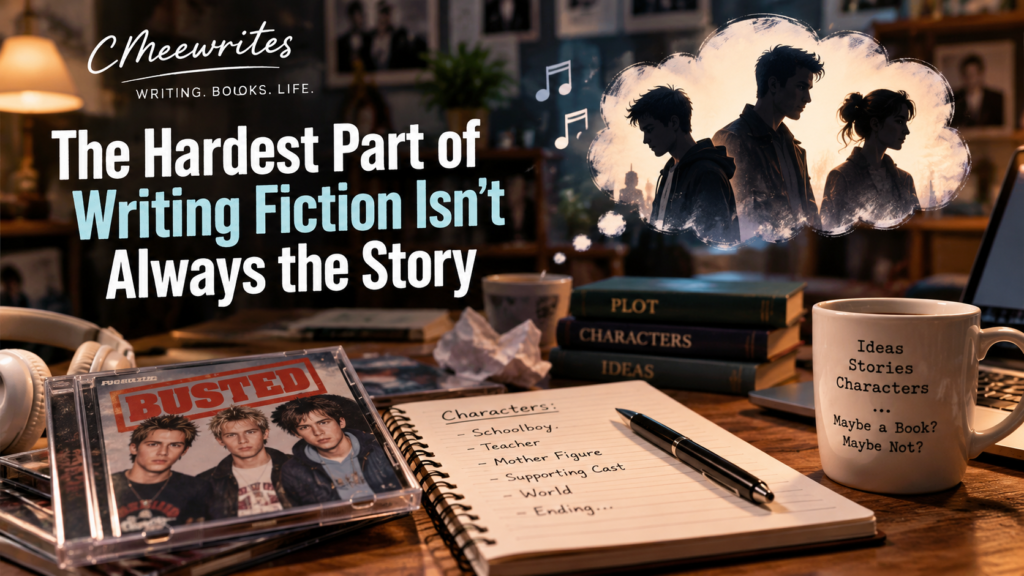
A Busted song.
Yes, seriously.
I was listening to Busted, and for some reason, I started wondering whether the premise behind one of their songs could actually work as a novel.
It was a stupid idea, really. The sort of thing you think about for five minutes before getting on with your day.
Except I didn’t.
I started thinking about how the story might work. Then I started developing the characters. Before I knew it, I’d worked out the central storyline, the supporting cast, the major turning points and even how the whole thing would end.
Not bad for something that started with a three-minute pop song.
There was just one rather inconvenient problem.
I had the story, but creating believable characters to make that story work was proving considerably harder.
And that’s what I’ve been thinking about recently.
A Story That Might Never Become a Book
Before anyone gets excited about another novel, I should probably make something clear.
This isn’t a book announcement.
It’s not something I’ve secretly added to my publishing calendar, and there’s no release date hiding somewhere in the background.
In fact, I don’t even know whether I’ll ever finish writing it.
I certainly don’t know whether it’ll ever be published.
At the moment, it’s simply a story I’m playing around with because I enjoy writing.
I’ve already got novels with publication dates, deadlines and all the other commitments that come with being an independent author. Those are the projects I’m actively working towards completing and publishing.
This one is different.
It’s something I can pick up whenever I feel like it, particularly when my back is giving me trouble and sitting at my Mac to work on my main manuscripts isn’t practical.
Sometimes I’ll spend a bit of time developing the story. Other times, I’ll think about the characters or work through a particular situation.
And sometimes I’ll leave it alone completely.
There’s no pressure to produce a certain number of words, finish a chapter or turn the idea into something I can eventually sell on Amazon.
I’m writing it because I want to.
And, strangely enough, having that freedom has made me think more seriously about creating believable characters.
Knowing What a Character Does Isn’t Knowing Who They Are
Here’s the problem I’ve encountered.
I know what I need from my three main characters.
I know their backgrounds, the roles they play in the story and how their relationships develop. I also know the major decisions they’ll make and how those decisions affect everything that follows.
I’ve even got a supporting cast worked out.
On paper, you might think I’ve done most of the difficult work.
But have I?
Knowing that a character has experienced a difficult childhood doesn’t automatically tell me what sort of person they’ve become.
Are they angry about what happened? Have they learned to hide their emotions? Do they struggle to trust people, or are they desperate to find someone they can depend on?
And even if I answer those questions, that doesn’t necessarily tell me how they’ll behave in every situation.
The same applies to someone who’s intelligent, successful or genuinely wants to help other people.
Those are characteristics, but they’re not an entire personality.
How do they react when someone challenges them? What happens when they’re frightened? Do they admit when they’re wrong, or are they the sort of person who’ll argue their way out of a situation even when they know they’ve made a mistake?
More importantly, how do I make all of that come across naturally without spending half a chapter explaining someone’s personality?
That’s the difficulty I’m facing.
I know what my characters need to be for the story to work. I’m still figuring out who they actually are.
And there’s a difference.
Creating Believable Characters Doesn’t Mean Making Them Perfect
One thing I’ve always believed about writing fiction is that characters don’t have to be perfect.
Actually, I think a novel where everyone makes sensible decisions, behaves reasonably and always does the right thing would be pretty bloody boring.
People aren’t like that.
We make mistakes. We say things we regret. We sometimes allow our emotions to get the better of us.
We can be incredibly sensible about one part of our lives and make a complete mess of another.
So why should fictional characters be any different?
When I’m creating believable characters, I’m not necessarily trying to make people the reader will like.
Of course, I want readers to connect with them. But connecting with a character doesn’t have to mean agreeing with everything they do.
A character might make a terrible decision.
The reader might think they’re being selfish, irresponsible or completely ridiculous.
That’s fine.
What matters to me is whether the reader understands why that character made the decision in the first place.
If someone has spent their entire life struggling to trust other people, I can’t suddenly have them placing complete faith in a stranger simply because it’s convenient for the plot.
Unless, of course, I’ve given them a believable reason to behave differently.
That’s where creating believable characters becomes complicated.
I can know exactly what I want to happen next, but if the character wouldn’t naturally behave in the way the story requires, I’ve got a problem.
And sometimes the answer isn’t to change the character.
Sometimes it’s to change the story.
When the Plot Comes Before the People
I’ve written before about the relationship between plot and character development.
In my earlier article, Plot vs Character: What I Focus on First (and Why It Changes), I explored how some stories begin with an interesting character while others start with an idea for a plot.
Neither approach is necessarily right or wrong.
Different stories develop in different ways.
But this particular project has presented me with a slightly different problem.
The plot came first.
And not just a vague idea about what might happen.
I’ve already worked out how the story begins, where the major conflicts occur and how everything eventually comes together.
I even know the final scene.
What I haven’t completely worked out is how to make the people involved feel like individuals rather than characters I’ve invented to move the plot along.
Because that’s the danger, isn’t it?
If I’m not careful, I could end up with characters who do exactly what the storyline requires, regardless of whether their behaviour makes any sense.
They’d become little more than pieces on a chessboard, moving wherever I decided to put them.
And that’s not what I want.
I want characters who have their own personalities, motivations and contradictions.
People who feel as though they existed before the first chapter and might continue living their lives after the final page.
Even if those lives only exist in the reader’s imagination.
The Freedom to Write Without Expectations
Something else I’ve discovered is how enjoyable it can be to work on a story without worrying about when it’ll be finished.
Normally, when I’m writing a novel, I’ve got a fairly clear idea of what I’m working towards.
There’s a manuscript to complete, editing to do, formatting to sort out and eventually a publication date.
I enjoy that process. After all, I wouldn’t keep writing and publishing books if I didn’t.
But there’s also something refreshing about having a project where none of that matters.
If I spend an afternoon trying to work out a character’s personality and don’t write a single word of the actual manuscript, so what?
If I decide something doesn’t work and change my mind, there’s no deadline hanging over me.
And if I leave the story untouched for a few weeks because I’m busy with something else, it doesn’t matter.
The whole thing might eventually become a complete novel.
Or I might reach a point where I realise the idea doesn’t work as well as I’d hoped.
Perhaps I’ll get halfway through writing it and lose interest.
I genuinely don’t know.
And for once, I’m perfectly happy with that.
Not everything I write has to become another book on Amazon.
Sometimes, writing can simply be about enjoying the process of creating something.
Even if that something never goes any further than a collection of notes and a few unfinished chapters.
Making Readers Believe in the Impossible
There’s another reason why creating believable characters matters so much to me.
I write fiction.
That means I can put people in situations that are unlikely, extraordinary or, in some cases, completely removed from anything most of us will ever experience.
That’s part of the enjoyment of storytelling.
But I don’t think the events themselves always have to be particularly likely for a story to work.
What matters is whether readers believe in the people experiencing them.
A character might find themselves facing an impossible decision.
They might become involved in something extraordinary or experience a situation that most readers will never encounter.
But if their emotions, reactions and decisions feel authentic, I think readers are far more willing to accept the circumstances surrounding them.
That’s the standard I try to work towards.
I don’t need every reader to agree with every decision my characters make.
I don’t even need them to like all my characters.
But I do want them to understand why those people behave as they do.
I want someone reading one of my novels to think, I can actually imagine a person like that existing.
Because if I’ve managed that, I feel I’ve done my job as a writer.
Sometimes the Story Is the Easy Part
Which brings me back to that bloody Busted song.
What started as a daft idea has somehow turned into a story with three main characters, a supporting cast, complicated relationships and an ending I’ve already worked out.
Whether it’ll ever become a finished novel is anybody’s guess.
And whether anyone will ever get the opportunity to read it is even more uncertain.
But that’s not particularly important at the moment.
I’m enjoying developing it.
I’m enjoying exploring the possibilities and trying to work out how everything fits together.
And I’m discovering that creating believable characters can sometimes require more thought than inventing an entire storyline.
Because having a character who serves a purpose in a novel is one thing.
Creating someone who feels like a real person is something else entirely.
I’ve got the story.
I’ve got the ending.
Now I’ve just got to figure out who the people in the middle really are.
All because I listened to a Busted song.
Honestly, sometimes I wonder about myself.
Over to You: Where Do Your Stories Begin?
If you’re a writer, I’d love to know whether you’ve ever found yourself in a similar situation. Have you ever had an entire storyline worked out but struggled to make the characters feel real?
And if you’re a reader, what makes a fictional character believable to you? Is it their personality, their decisions, their flaws or simply the feeling that they could be someone you’d meet in everyday life?
Share your thoughts in the comments below. I’d be interested to hear how other people see it.
And if you’d like to explore more of my thoughts on writing, the creative process and life as an independent author, visit CMeewrites to discover my published novels and more from behind the scenes.
After all, you never know where the next story might come from.
Apparently, neither do I.