
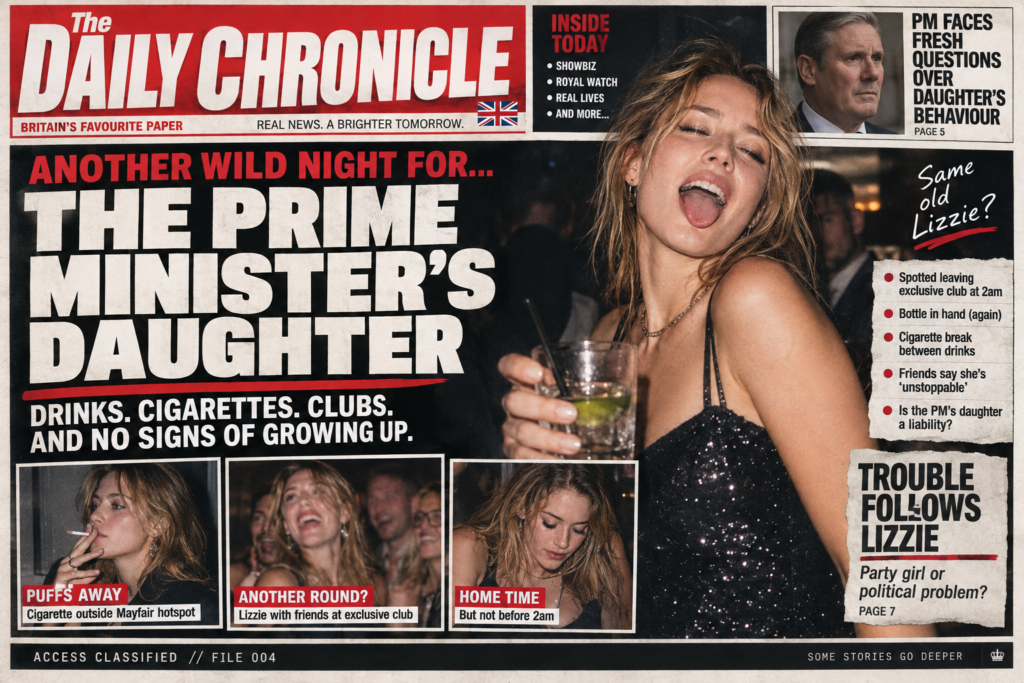
SUBJECT: ELIZABETH “LIZZIE” WETHERBY
CLASSIFICATION: CHARACTER DEVELOPMENT
Creating Lizzie Wetherby: More Than the Prime Minister’s Daughter
Twenty years old.
Prime Minister’s daughter.
Smoker.
Drinker.
Regularly photographed on nights out.
Difficult.
Reckless.
A bit of a pisshead.
If you reduced Lizzie Wetherby to the version of her that exists in the newspapers at the beginning of The Prime Minister’s Daughter, that’s probably about it.
And that’s deliberate.
Because one of the things I wanted to explore when I created Lizzie was how quickly somebody can become a public character rather than a real person.
Elizabeth Wetherby is the daughter of the Prime Minister. That makes her interesting to newspapers whether she wants to be interesting or not.
If she goes out with her friends and gets pissed, there’s a photograph.
If she has a cigarette outside somewhere, there’s a photograph.
If she gets annoyed with a photographer following her, the photograph probably becomes even more valuable.
Normal twenty-year-old behaviour suddenly becomes evidence that the Prime Minister has a troublesome daughter.
But that’s Elizabeth Wetherby.
The woman the public thinks it knows.
Lizzie is considerably more complicated.
Everybody Thinks They Know Lizzie Wetherby
One of my favourite lines very early in The Prime Minister’s Daughter is essentially the starting point for the whole character.
Everybody knows Elizabeth Wetherby.
Or, more accurately, everybody thinks they do.
Luke Dawson certainly thinks he does.
When he’s told that his first assignment as a newly promoted Detail Leader is protecting the Prime Minister’s daughter, he already knows the headlines. Nights out. Cigarettes. Arguments with photographers. The ordinary mistakes of a twenty-year-old turned into national news because her father happens to live in Number 10.
And then Luke actually has to meet her.
That’s where things become more interesting.
I didn’t want Lizzie Wetherby to be secretly perfect.
The point isn’t that every newspaper story about her is a lie and underneath it all she’s actually some flawless young woman who spends Saturday nights reading Shakespeare and volunteering at an orphanage.
She does drink.
She does smoke.
She does go out.
She can be difficult.
She can make Luke’s job considerably harder than it needs to be.
But those things aren’t her entire personality.
Luke can’t afford to reduce her to them because he’s suddenly responsible for keeping her alive.
And to protect somebody properly, you probably need to understand who you’re actually protecting.
What If You Suddenly Had Armed Strangers Running Your Life?
This was one of the biggest things I wanted to get right with Lizzie Wetherby.
It would have been incredibly easy to write her resistance to protection as stupidity.
There’s a threat against you. The Government Protection Department gives you a team of highly trained armed protection officers. Stop complaining and do what you’re told.
Simple.
Except I don’t think it would actually feel simple if you were the person being protected.
Before her father becomes Prime Minister, Lizzie has a life.
She goes out with her friends. She runs. She smokes. She drinks. She changes her mind. She makes spontaneous plans.
Then her father’s job changes and, eventually, the threat against her becomes serious enough that GPD decides she needs permanent dedicated protection.
Suddenly there are armed strangers in her life.
Where are you going?
Who are you meeting?
What time are you leaving?
How are you getting there?
When are you coming back?
Have the plans changed?
Who else is going to be there?
To Luke, those questions are operational.
To Lizzie, they can feel like somebody has just appointed themselves manager of her life.
That’s an important distinction.
Protection Isn’t Ownership
This became one of the central questions behind writing Luke and Lizzie Wetherby:
How do you protect somebody without taking ownership of their life?
Luke needs information.
He needs to understand Lizzie’s movements, assess locations, plan routes, identify vulnerabilities and make sure his team can respond if something goes wrong.
That’s his job.
But being responsible for Lizzie’s safety doesn’t suddenly make Luke responsible for Lizzie.
There is a difference.
He doesn’t get to decide whether she goes out because he’d rather she stayed inside.
He doesn’t get to decide who her friends are.
He doesn’t get to turn every security recommendation into an order simply because carrying a gun makes him the most qualified person in the room to assess a threat.
Lizzie still has to be allowed to live.
And that creates friction because there are moments when what Lizzie wants and what Luke needs are genuinely incompatible.
Neither of them has to be an idiot for that conflict to exist.
I Didn’t Want Lizzie to Become the Woman Who Gets Rescued
Political thrillers can very easily fall into a familiar trap.
You create an extremely capable male protagonist. Give him military experience, weapons training and a job that involves protecting people.
Then you give him a woman to protect.
She becomes the target.
He becomes the hero.
She gets kidnapped, attacked or threatened at convenient intervals so that he can demonstrate how brilliant he is.
I didn’t want that for Lizzie Wetherby.
Yes, Luke Dawson is considerably better equipped to deal with somebody trying to kill them.
That’s unavoidable.
He’s a former Royal Marine and SAS soldier who has spent years in armed policing and close protection. Lizzie is a twenty-year-old civilian.
Pretending she can suddenly match him tactically would be ridiculous.
But physical capability isn’t the same thing as character agency.
Lizzie doesn’t need to become an action hero to remain an active character in her own story.
She can challenge Luke.
She can disagree with him.
She can make decisions he doesn’t like.
She can force him to recognise that the easiest way to protect somebody isn’t necessarily the right way to let them live.
Most importantly, the story can treat her decisions as meaningful rather than simply waiting for Luke to tell her what to do.
Why Luke and Lizzie Clash
When Luke Dawson and Lizzie Wetherby first meet, neither particularly understands the other.
Luke sees a principal.
More specifically, he sees a principal with a reputation for being difficult, resistant to protection and prone to making life harder for the people responsible for her safety.
Lizzie sees another armed babysitter.
Someone else sent into her life because of her father’s job.
Luke thinks she’s reckless.
Lizzie thinks he’s controlling.
And, from where each of them is standing, they’re not entirely wrong.
That’s what makes their early arguments work for me.
I didn’t want arguments inserted simply because Luke and Lizzie are the two central characters and therefore need some convenient romantic tension.
Their arguments come from a genuine collision between two legitimate needs.
Luke needs enough control over the environment to protect her.
Lizzie needs enough control over her own life to remain a person rather than a protected object.
There isn’t always a neat compromise between those things.
Sometimes Luke genuinely does need Lizzie to do exactly what she’s told.
Sometimes Lizzie is absolutely entitled to tell him to piss off.
Working out which situation they’re actually in is part of their relationship.
Then Somebody Actually Tries to Kill Her
The first assassination attempt changes things.
Not instantly.
And that’s important.
I didn’t want somebody to try to kill Lizzie and suddenly have her emerge from the experience as the perfect protected principal who obediently follows every instruction Luke gives her.
That wouldn’t feel believable.
But something does change.
Until that point, much of what Luke and the protection team do can feel theoretical to Lizzie.
Threat assessments.
Routes.
Positioning.
Vehicles.
Advance work.
Officers constantly watching the people around her.
All the irritating little restrictions that have invaded her life.
Then somebody actually tries to kill her.
And Luke doesn’t hesitate.
All the professional distance and all the arguments disappear because, at the moment it matters, Luke does exactly what he was put there to do.
He puts himself between Lizzie and the threat.
For Lizzie, that’s the moment when the annoying rules acquire a different meaning.
They’re still annoying.
She still doesn’t surrender control of her life.
But now she understands what sits behind them.
The people around her aren’t there because they enjoy telling her what to do.
They’re there because somebody might genuinely try to kill her — and if that happens, those officers are expected to move towards the danger rather than away from it.
That changes the way she sees Luke.
Luke Has to Change as Well
The development isn’t one-sided.
It would have been easy to make the first assassination attempt the moment Lizzie finally realises Luke was right about everything.
But that would completely miss the point.
Luke has things to learn as well.
The longer he protects Lizzie Wetherby, the more difficult it becomes to reconcile the woman standing in front of him with the version he thought he knew from the newspapers.
He starts seeing the person underneath the reputation.
He sees the pressure of living as the Prime Minister’s daughter.
He sees what constant attention does to somebody who never stood for election and never asked for public office.
He sees the parts of Lizzie that don’t make good tabloid headlines.
And gradually, she’s no longer simply Elizabeth Wetherby, principal.
She’s Lizzie.
That’s a subtle distinction, but it’s an important one.
Trust Has to Be Earned
Luke and Lizzie’s relationship is obviously important to The Prime Minister’s Daughter, but I never wanted to rush it.
For me, the interesting part isn’t two characters looking at each other and immediately deciding they’re attracted to one another.
It’s watching two people who initially misunderstand each other gradually realise that their first impressions were incomplete.
Lizzie learns what Luke’s job actually costs.
Luke learns what being protected costs Lizzie.
She begins to trust his judgement because she sees what happens when the threat stops being theoretical.
He begins to trust her because he starts recognising that protecting her doesn’t mean removing her ability to make decisions.
That doesn’t magically stop them arguing.
If anything, being able to challenge each other becomes part of the trust.
Because trust isn’t obedience.
And protection shouldn’t require it.
The Person Behind the Headline
That’s probably the biggest thing I wanted Lizzie Wetherby to represent.
The public version of somebody is rarely the complete version.
The newspapers can call her difficult.
They can call her reckless.
They can photograph her smoking outside a club, write about how much she’s had to drink and turn another night out into evidence of a Prime Minister struggling to control his daughter.
They can call her a pisshead if they want.
Luke doesn’t have that luxury.
His job requires him to look closer.
He has to understand where Lizzie goes, how she behaves, who she trusts, what frightens her, what makes her angry and why she pushes against the restrictions surrounding her.
Because protecting Elizabeth Wetherby means understanding Lizzie.
And somewhere underneath all the headlines, arguments, security briefings and armed officers, there’s still a twenty-year-old woman trying to work out how much of her life still belongs to her.
For me, that’s what made her considerably more interesting than simply the Prime Minister’s daughter.
ACCESS REMAINS OPEN
What do you make of Lizzie Wetherby? Would permanent close protection make you feel safer, or would having armed officers suddenly involved in almost every part of your life drive you absolutely mad?
Share the article, leave a comment and let me know.
And if you want to go deeper into The Prime Minister’s Daughter, Luke Dawson, the Government Protection Department and the other characters and operations behind the trilogy, head over to the ACCESS CLASSIFIED section:
CMeewrites® — stories, characters and the thinking behind them.