
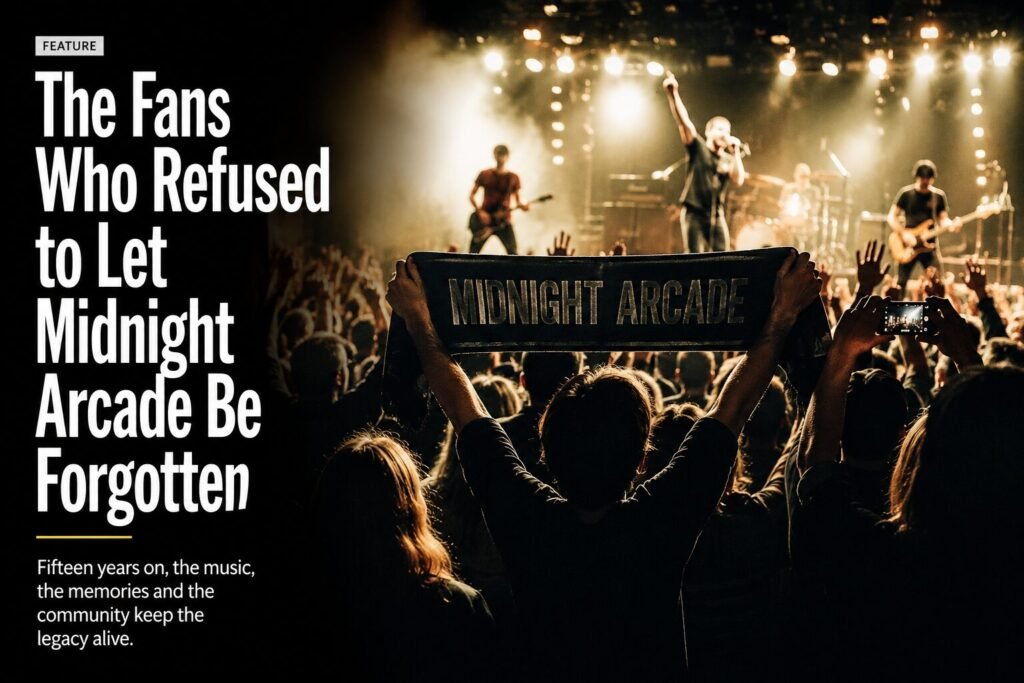
Most bands leave their legacy in the hands of record labels.
Anniversary editions are released. Greatest hits albums appear every few years. Streaming platforms quietly place familiar songs in carefully curated playlists, and the music continues to exist because the industry decides there is still value in keeping it alive.
Midnight Arcade’s legacy followed a very different path.
Their story ended long before anyone expected it to, leaving behind one studio album, a growing catalogue of unforgettable live performances and thousands of fans who suddenly found themselves asking the same question.
What happens now?
The answer, it turned out, was remarkably simple.
The fans took over.
Nobody organised it.
There was no official campaign or grand plan. Instead, thousands of individual decisions gradually combined into something extraordinary. Someone loaned an old CD to a friend. Somebody uploaded a live recording from the back of a crowded venue. Someone else dug out an old ticket stub and shared the story behind it online.
Little by little, Midnight Arcade stopped becoming just a band people remembered.
They became a band people actively introduced to others.
Fifteen years later, that’s exactly why their music still matters.
Their legacy isn’t measured by chart positions or sales figures.
It’s measured by the thousands of people who refused to let the songs disappear.
Passing The Music Forward
The easiest way for music to disappear is for people to stop recommending it.
That never happened with Midnight Arcade.
Ask almost any long-time fan how they introduced someone to the band and you’ll hear a surprisingly similar story.
“I told them to listen to Run With the Lights On.”
From there, curiosity usually did the rest.
People discovered Static Between Streetlights, then searched for live performances, then inevitably found themselves wondering why they’d never heard of one of Britain’s most exciting indie bands.
Every new listener became another person carrying the music forward.
Original CDs still change hands today.
Some have cracked cases.
Others contain handwritten notes tucked inside the booklet from the friend who first passed them on.
Streaming has only widened that audience.
Songs appear on playlists celebrating forgotten British indie gems, while fan-created lyric videos continue attracting viewers hearing Ben Carter’s voice for the very first time.
Perhaps even more important are the live recordings.
They’re shaky.
They’re distorted.
They’re wonderfully imperfect.
The person filming usually forgets to keep the camera steady because they’re too busy singing along.
That’s precisely why they matter.
These aren’t polished concert films.
They’re memories.
They’re the closest thing younger fans have to standing in a packed room while Ryan Hale tears into another solo, Marc Iqbal counts the band into one final chorus and Danny Brooks smiles across the stage as hundreds of voices sing every word back at Ben Carter.
Those videos don’t simply preserve performances.
They invite people into them.
Every view creates another fan.
Every recommendation keeps the story moving.
A Community That Became Custodians
Over time, Midnight Arcade’s online fan communities became something few people could have predicted.
They stopped behaving like fan clubs.
Instead, they became caretakers.
Facebook groups, Reddit discussions and old forums slowly transformed into living archives, filled with concert photographs, faded wristbands, backstage passes and ticket stubs rescued from drawers and shoeboxes.
Someone uploads an old setlist.
Another fan remembers the encore.
A third posts a photograph taken moments before the lights went down.
Piece by piece, the band’s history continues to grow.
The conversations aren’t dominated by loss.
They’re filled with excitement.
People debate the greatest version of Heartbeat ever played live.
They compare different performances of Run With the Lights On.
They tell newcomers which live recording they absolutely have to watch first.
The goal isn’t simply to remember Midnight Arcade.
It’s to make sure someone discovers them tomorrow.
Daylight Arcade: More Than A Tribute Band
Perhaps the greatest example of that philosophy can be found on stages across the country.
Daylight Arcade didn’t begin with the ambition of becoming a touring band.
Originally, they planned to do what countless musicians have done before them.
They wanted to become a tribute act.
But somewhere between those first rehearsals and their earliest performances, something changed.
“We realised pretty quickly that we weren’t trying to recreate Midnight Arcade,” explains lead singer Emily.
“Nobody can do that.
“What we could do was make sure the songs were still being heard.”
That simple change in thinking transformed the entire project.
Rather than copying hairstyles, stage movements or between-song banter, Daylight Arcade focused entirely on the music.
Every arrangement was approached with respect.
Every performance became an opportunity to introduce someone new to the songs.
Guitarist Steve believes that’s the responsibility they accepted the moment they decided to continue.
“We’re not standing on stage pretending to be Ben, Ryan, Marc and Danny,” he says.
“Those four musicians wrote something special, and our job is simply to keep those songs alive.
“If someone leaves one of our gigs and listens to Static Between Streetlights for the first time, that’s a success.
“If a teenager discovers Midnight Arcade because they came to see us with their parents, that’s an even bigger success.”
Attend a Daylight Arcade concert today and you’ll find long-time Midnight Arcade fans standing alongside people who weren’t even born when the original band were performing.
Some arrive already knowing every lyric.
Others hear Run With the Lights On for the very first time.
By the end of the evening, they’re singing together.
That’s no longer nostalgia.
That’s legacy continuing to grow.
And perhaps that’s the greatest tribute anyone could pay.