
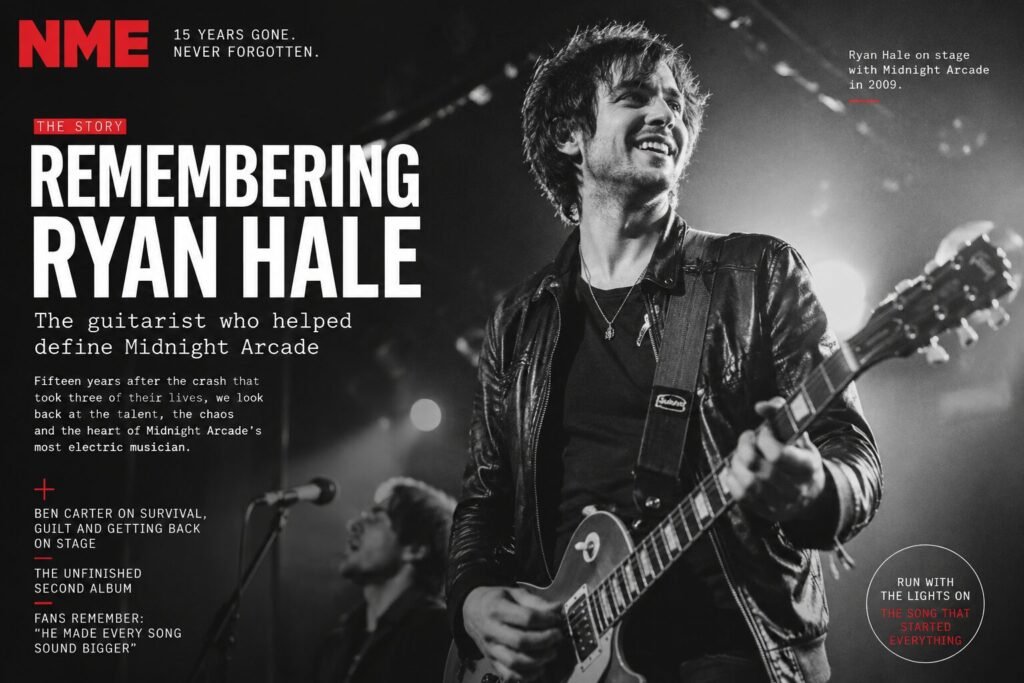
Fifteen years later, the image remains unchanged.
Ryan Hale stands stage right, guitar slung low against a battered leather jacket, grinning across the stage at Ben Carter as Midnight Arcade launch into Run With the Lights On. The crowd are already singing the opening line before the first chorus arrives. Ben rolls his eyes at something Ryan has said between songs. Ryan laughs. Then he turns back to the audience and unleashes the riff that would become synonymous with the band.
It lasts only a few seconds.
For many fans, those few seconds have lasted fifteen years.
Midnight Arcade’s story has become one of modern British music’s great unfinished narratives. A band on the rise. A debut album that felt like the beginning of something bigger. A second record left half-written. A motorway crash that ended everything before anyone involved had fully discovered who they might become.
And yet whenever people discuss Midnight Arcade today, one name appears with remarkable consistency.
Ryan Hale.
Not because he was the loudest member of the band.
Not because he was the frontman.
Not even because he was necessarily the most talented.
People remember Ryan because he seemed to embody something that every great band needs.
Momentum.
He was the spark.
The person always pushing forwards.
The person who refused to settle.
The person who made everyone around him slightly better than they would have been otherwise.
Fifteen years after his death, fans still trade stories about him online. Grainy live clips still circulate on social media. Guitarists still attempt to replicate parts from Static Between Streetlights. People who saw Midnight Arcade play tiny venues before everything ended still speak about Ryan with surprising affection.
The question is why.
Why does Ryan Hale continue to matter?
The answer begins long before anyone outside a handful of Midlands venues had heard of Midnight Arcade.
By most accounts, Ryan arrived exactly as he would remain.
Loud.
Funny.
Charismatic.
Slightly chaotic.
Former promoter Gavin Marshall, who booked some of the band’s earliest shows, once described him as “the only guitarist I’ve ever met who could lose his phone twice in the same afternoon and somehow make it everyone else’s fault.”
The stories are endless.
Turning up late because he’d forgotten where he parked.
Spending an hour perfecting a guitar tone before discovering the amplifier wasn’t plugged in.
Talking his way into free drinks he couldn’t afford.
Convincing strangers they had known each other for years.
People liked him.
That sounds simple, but it matters.
Music scenes are full of talented musicians. They’re less full of people capable of making every room feel warmer the moment they walk into it.
Ryan had that gift.
Yet beneath the confidence sat a work ethic that surprised almost everyone who knew him.
His public image suggested spontaneity.
The reality was obsession.
Friends recall him disappearing after rehearsals only to spend another three hours alone with a guitar.
He studied live performances relentlessly.
He replayed recordings repeatedly.
He rewrote parts he claimed had appeared fully formed.
Many musicians develop a mythology around effortlessness. Ryan was no different.
He wanted people to believe great riffs simply arrived.
The truth was far less glamorous.
He worked for them.
Hard.
That work became central to Midnight Arcade’s identity.
The band’s sound depended on contrast.
Ben Carter’s voice carried vulnerability and restraint. Marcus Iqbal’s drumming provided structure. Danny Brooks anchored everything emotionally through melodic basslines.
Ryan supplied movement.
His guitar parts rarely dominated songs.
Instead, they expanded them.
Listen carefully to Static Between Streetlights and a pattern emerges.
A clean line weaving through a verse.
A subtle harmonic flourish before a chorus.
A melody hidden beneath the obvious melody.
The details reveal themselves slowly.
Those details were often Ryan’s obsession.
Former studio engineer Matt Pearson remembers countless arguments about riffs that most listeners would never consciously notice.
“Everybody else would have been happy,” he recalls. “Ryan never was. He’d say, ‘It’s fine. Fine isn’t the same as right.’”
That attitude shaped the album.
Several of Midnight Arcade’s most memorable guitar moments reportedly emerged after Ryan refused to accept early versions.
One riff took three days.
Another was rewritten hours before recording.
A third survived only because Ryan insisted everyone stop trying to improve it.
Perfectionism came naturally to Ben Carter.
Ryan’s gift was directing that perfectionism somewhere useful.
Their creative partnership became the foundation upon which Midnight Arcade was built.
If Ben provided the emotional centre of the band, Ryan provided the challenge.
He was one of the few people willing to tell the frontman when he was wrong.
Or overthinking.
Usually both.
Whenever Ben disappeared into endless revisions, Ryan had a phrase.
“Carter.”
Nothing more.
Just Carter.
One word.
Sometimes accompanied by a raised eyebrow.
Sometimes followed by a lecture.
Sometimes followed by a guitar being thrust into his hands.
According to friends, everyone knew what it meant.
Stop thinking.
Start doing.
The relationship worked because neither man wanted the other’s job.
Ben didn’t want to be lead guitarist.
Ryan didn’t want to be frontman.
Instead, they pushed each other towards becoming better versions of themselves.
Ben made Ryan focus.
Ryan made Ben take risks.
Several people who witnessed the band during those years describe conversations that sounded less like arguments and more like two people pulling each other forwards.
Ryan believed Ben could go bigger.
Ben believed Ryan could go deeper.
Midnight Arcade emerged somewhere in the middle.
It’s impossible to know what that partnership might have produced given another decade.
That’s part of what makes the story linger.
The crash ended not only lives, but possibilities.
By now the facts are familiar.
The band were travelling to their next show when the tour coach crashed on the motorway.
Ryan Hale died alongside Marcus Iqbal and Danny Brooks.
Ben Carter survived.
The mechanics of the accident have been examined elsewhere.
What remains more interesting fifteen years later is the absence it created.
Friends lost a friend.
Families lost sons and brothers.
Fans lost a band they believed was only just beginning.
Ben lost the people who understood him best.
And music lost whatever came next.
Perhaps that is why Ryan’s legacy feels unusually personal.
Unlike artists who leave behind decades of work, Ryan left fragments.
Potential.
Questions.
A debut album.
A collection of live recordings.
Stories.
The unfinished second album has become particularly significant.
Those close to the band have occasionally hinted at material that never reached completion.
Half-finished songs.
Voice notes.
Demo recordings.
Ideas scribbled in notebooks.
No one can say with certainty what those songs would have become.
That uncertainty has created its own mythology.
Fans often speculate that Ryan’s strongest work remains unheard.
Whether that’s true is almost irrelevant.
The belief itself says something.
People still imagine what he might have created.
That doesn’t happen accidentally.
Of course, mythology has a habit of smoothing away humanity.
The real Ryan Hale was considerably messier.
He chewed guitar picks until they split.
He lost his phone so often that friends stopped helping him look.
He always seemed to smell faintly of peppermint gum.
He claimed to hate love songs despite secretly writing several.
One survives in demo form.
Another reportedly became the basis of a Midnight Arcade track few listeners realised was romantic.
He practised far longer than he ever admitted.
He worried more than he let people see.
One former band associate recalls finding him alone after rehearsal, replaying the same section repeatedly.
When asked why, Ryan simply shrugged.
“Not good enough yet.”
That answer appears again and again whenever people discuss him.
Not good enough yet.
The confidence was real.
So was the insecurity.
The charm was real.
So was the fear.
The talent was real.
So was the effort.
Those contradictions are what make him memorable.
Not because they are extraordinary.
Because they are familiar.
People recognise themselves in them.
Perhaps that’s why Ryan’s legacy has endured while so many promising musicians disappear from public memory.
He doesn’t feel like a symbol.
He feels like a person.
A person who happened to create music that connected with people.
A person who happened to leave before his story was finished.
Today, fifteen years later, fans still share old videos online.
Songs from Static Between Streetlights still appear on playlists.
Stories still pass between people who were lucky enough to see Midnight Arcade in crowded venues before the wider world noticed.
The band’s audience has grown in an unusual way. Some listeners discovered them in real time. Others arrived years later, drawn by recommendations, algorithms, and curiosity.
They all encounter the same thing.
The sense that something was beginning.
And at the centre of that feeling is Ryan Hale.
The guitarist grinning stage right.
The friend calling across the stage.
The musician who believed good enough wasn’t enough.
The young man who never got to become the artist he was supposed to become.
But perhaps legacy isn’t measured by what someone becomes.
Perhaps it is measured by what remains.
The songs remain.
The stories remain.
The influence remains.
Most importantly, the connection remains.
Fifteen years later, people still talk about Ryan Hale not because he died young, but because for a brief moment he helped create music that mattered.
Some musicians leave behind records.
Ryan Hale left behind echoes.
Fifteen years later, people are still listening.