
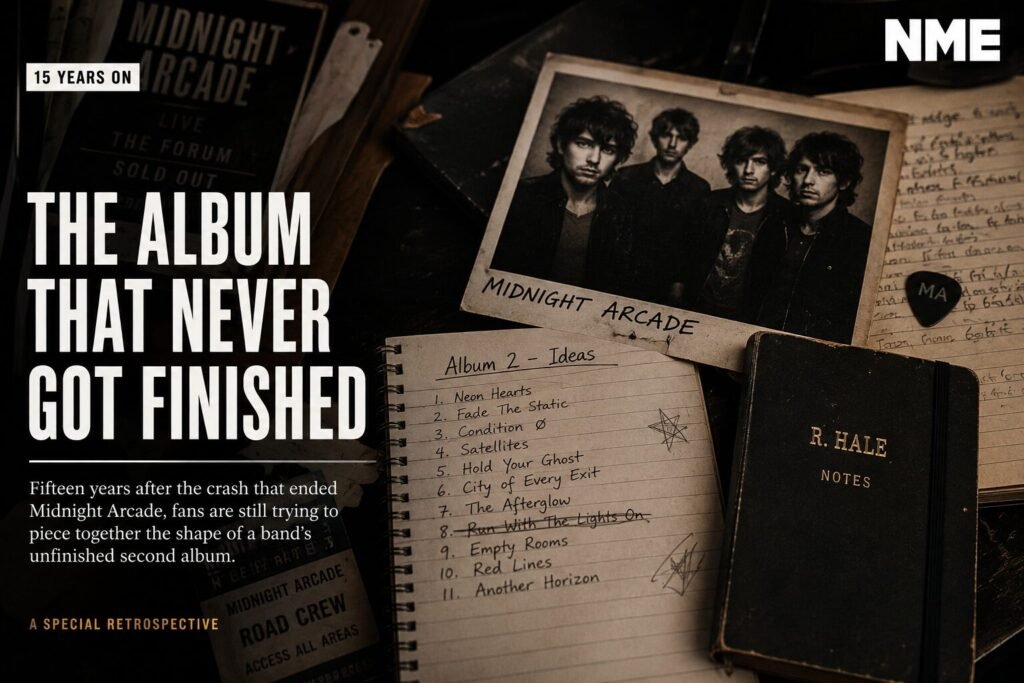
Fifteen years after the crash that ended Midnight Arcade, fans are still trying to piece together the shape of an album that never had the chance to exist.
Some records become legendary because of what they achieve.
Others become legendary because they never arrive at all.
Fifteen years after the crash that killed three members of Midnight Arcade and brought one of Britain’s most promising indie bands to an abrupt end, discussion around the group’s unfinished second album remains surprisingly active. Browse fan forums, Reddit threads, old music message boards or social media pages dedicated to the band and the same question appears again and again:
What would the second album have sounded like?
Nobody knows.
That uncertainty is precisely what keeps the fascination alive.
The band’s debut album, Static Between Streetlights, was never intended to become a defining record of its era. Released with modest expectations, it quietly built momentum through word of mouth, relentless touring and songs that felt simultaneously intimate and expansive.
The album arrived during a period when indie music was crowded with guitar bands chasing the same audience. Yet Midnight Arcade managed to stand out. Their songs possessed a rare sense of emotional patience. They understood how to build tension rather than simply chase hooks.
At the centre of everything was the partnership between vocalist and lyricist Ben Carter and lead guitarist Ryan Hale.
Carter provided the emotional framework.
Hale provided the movement.
Together they created songs that seemed to breathe.
As Static Between Streetlights gained traction, audiences grew. Small rooms became larger ones. Support slots became headline shows. Industry attention intensified.
And almost immediately, questions began about what would come next.
According to people close to the band at the time, the answer was already taking shape.
The second album had begun.
Not officially.
Not in expensive studios with release dates circled on calendars.
But in rehearsal spaces, tour vans, soundchecks and late-night hotel rooms.
Like most second albums, it started as fragments.
A lyric scribbled in a notebook.
A guitar melody recorded on a phone.
A chorus sung into a voice recorder before it disappeared.
What separates the second Midnight Arcade album from thousands of other unfinished records is that those fragments never had the opportunity to become anything more.
The crash froze them in place forever.
Former venue staff who worked with the band during their final year often describe a group beginning to stretch beyond the sound that had first attracted attention.
“They were definitely getting bigger,” recalls one former sound engineer who mixed several regional shows during their final tour.
“Not bigger commercially. Bigger musically. You could hear it in soundchecks. They were trying things. Longer intros. Different textures. Stuff they wouldn’t have attempted two years earlier.”
Others tell similar stories.
A promoter from Manchester remembers hearing songs during afternoon rehearsals that never appeared on any released material.
“They sounded familiar but different. Same band, but more ambitious. Like they were seeing how far they could push themselves.”
Exactly how far that ambition would have gone remains impossible to know.
The mythology surrounding unfinished albums often encourages fans to imagine masterpieces. Reality is usually messier. Most records evolve dramatically between demo and release. Songs are rewritten. Choruses disappear. Entire tracklists are abandoned.
The second Midnight Arcade album would almost certainly have changed repeatedly before reaching listeners.
Yet traces of its existence remain.
Over the years, stories have emerged from former crew members, friends and industry contacts about notebooks left behind in rehearsal rooms, demo CDs passed between producers and rough recordings that circulated briefly among insiders.
None provide a complete picture.
Most raise more questions than they answer.
One producer who attended an early writing session described hearing “three or four genuinely finished songs and a dozen ideas that clearly weren’t there yet.”
Another remembers Carter arriving with pages of handwritten lyrics and leaving with many of them crossed out.
“He rewrote constantly,” they recall. “Nothing was ever finished in his head.”
That perfectionism appears to have been balanced by Hale’s more instinctive approach.
People who witnessed their writing process often describe a creative partnership built on tension.
Carter analysed.
Hale reacted.
One would pull songs apart.
The other would push them forward.
Several former associates have described moments where an entire arrangement changed because Hale challenged a lyric or Carter rejected a guitar part.
Neither seemed interested in taking the easy option.
Perhaps that is why fans remain so convinced the second album might have surpassed the first.
Not because success guarantees improvement.
But because all available evidence suggests Midnight Arcade were still moving.
Still growing.
Still discovering who they were.
Over time, the mystery has produced its own folklore.
Rumoured song titles have circulated online for years.
Some appear credible.
Others are almost certainly inventions.
Fans frequently reference titles supposedly found in old setlists, studio notes or rehearsal schedules. Names emerge repeatedly across discussions before disappearing again into speculation.
No verified tracklist has ever surfaced.
No authoritative source has confirmed which songs were completed and which remained unfinished.
That absence of certainty has not stopped people trying.
Entire online communities have dedicated themselves to reconstructing the album.
One fan-created project attempted to organise every known fragment of information into a hypothetical track order.
Another analysed live recordings searching for unfamiliar melodies hidden within soundchecks.
Some fans compare lyric excerpts allegedly sourced from notebooks.
Others debate whether certain B-sides were actually prototypes for later material.
The results often contradict one another completely.
Yet the effort itself says something important.
People are not simply mourning the music that existed.
They are mourning the music that never got the chance to exist.
There is a long tradition of unfinished albums becoming cultural obsessions.
Music history is filled with projects frozen in development.
Albums abandoned due to creative disagreements.
Records interrupted by illness.
Songs left incomplete following tragedy.
What fascinates audiences is rarely the material itself.
It is possibility.
Human beings are naturally drawn to unfinished stories because unfinished stories remain perfect in our imagination.
The second Midnight Arcade album exists in exactly that space.
Nobody can criticise it.
Nobody can call it disappointing.
Nobody can argue the production was wrong or the singles were poorly chosen.
Because it never arrived, it remains untouched by reality.
Every listener carries a different version in their head.
Some imagine a darker record.
Others imagine a larger, more cinematic one.
Some believe the band would have embraced mainstream success.
Others insist they would have doubled down on intimacy.
All of those interpretations are equally valid because none can be disproved.
Perhaps the most revealing comments come from those who worked closest to the band.
When asked what the album might have become, they rarely describe specific songs.
Instead, they talk about momentum.
About curiosity.
About a group that had not yet settled.
“They weren’t finished becoming Midnight Arcade,” says one former collaborator.
That may be the real loss.
Not simply an unreleased album.
Not even a collection of songs.
But a creative evolution interrupted.
A debut album tells listeners who a band are.
The second album often reveals who they might become.
Midnight Arcade never received that opportunity.
Fifteen years later, Static Between Streetlights remains the only full studio album the band completed. It stands as both achievement and question mark.
A snapshot of a group caught in motion.
And somewhere beyond it sits the outline of another record.
Half-written.
Half-imagined.
Scattered across notebooks, demo recordings, abandoned ideas and fading memories.
A record that belongs as much to speculation as it does to history.
Most albums are judged by what they become.
The second Midnight Arcade album is remembered for what it never had the chance to be.
Fifteen years later, that unanswered question remains one of the most enduring parts of the band’s legacy.