
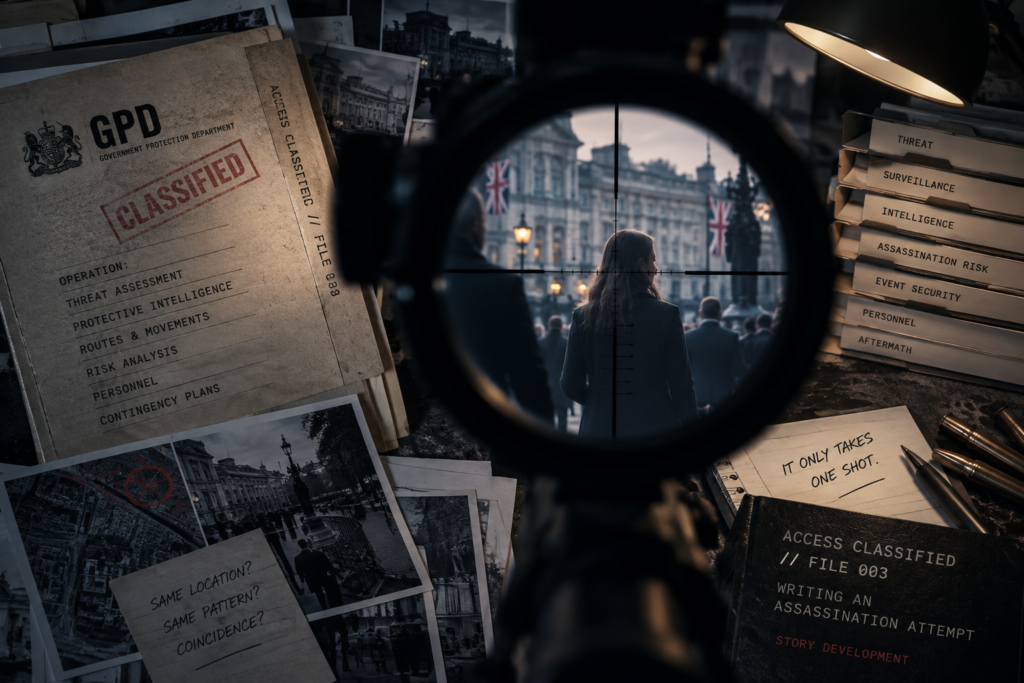
SUBJECT: Writing an Assassination Attempt
CLASSIFICATION: STORY DEVELOPMENT
There are certain things you know you’re going to have to write when you decide to write a political thriller.
Political manoeuvring.
Security briefings.
People in suits arguing behind closed doors.
And, when your story revolves around the Prime Minister’s daughter being placed under protection because somebody wants her dead, eventually you’re going to have to think seriously about writing an assassination attempt.
You’d think that would be the easy bit.
Put somebody with a gun in the right place. Have them start shooting. Let Luke Dawson and the Government Protection Department do their thing.
Job done.
Except it really isn’t.
When I started working through the assassination threat in The Prime Minister’s Daughter, I realised fairly quickly that the actual attack was almost the least complicated part of it.
The difficult bit was making everything around it believable.
Because I’ve spent a lot of time establishing that Luke and the GPD are bloody good at what they do.
If I then make them all idiots because I fancy writing a gunfight, I’ve broken my own world.
So writing an assassination attempt became less about finding an exciting way to put Lizzie Wetherby in danger and more about answering a much harder question.
How can something go wrong when the people trying to prevent it are actually competent?
Welcome to Access Classified File 003.
This one is about the writing rather than what actually happens in the novel.
Anything beyond that remains classified.
THE PROBLEM
There’s an obvious problem with writing an assassination attempt against an important character.
Readers know they’re reading a book.
They understand how stories work.
That doesn’t mean a major character can’t die, obviously, but simply pointing a weapon at somebody isn’t automatically enough to create tension.
The reader needs something more than:
Will the bullet hit them?
For me, that meant the assassination threat had to exist as part of the story long before any actual attack.
Lizzie isn’t suddenly in danger because I’ve reached the point in the manuscript where I think it could do with some action.
The threat to her is one of the reasons Luke is there in the first place.
He’s responsible for protecting her.
Lizzie has to live with that protection.
And those two things create tension before anybody gets anywhere near pulling a trigger.
Because protection is ultimately about preparing for something you desperately hope never happens.
Thriller writing has the slightly inconvenient problem that eventually something probably has to.
BUILDING THE THREAT
This is where I found writing an assassination attempt became much more about anticipation than action.
If the first indication of danger is somebody suddenly producing a gun, I haven’t really built a threat.
I’ve produced a surprise.
There’s a difference.
I wanted the danger surrounding Lizzie to feel as though it was tightening gradually.
Information changes.
The threat picture changes.
Protection arrangements change.
Something that wasn’t concerning yesterday might suddenly deserve another look today.
Luke and his team have to react to what they know without having the enormous advantage that I have as the author.
I know what’s going to happen.
They don’t.
And neither should the reader.
That’s where the Protective Intelligence side of the GPD became particularly useful when building the world.
Intelligence doesn’t necessarily arrive as one convenient piece of information containing everything you need to know.
It’s fragments.
Some of them matter.
Some of them don’t.
Some of them might matter, but nobody knows why yet.
And the protection operation has to function inside that uncertainty.
That’s much more interesting to me than giving Luke a convenient warning that says:
ASSASSINATION ATTEMPT AT THREE O’CLOCK. PLEASE PLAN ACCORDINGLY.
DON’T MAKE THE PROFESSIONALS STUPID
This became one of my biggest rules.
If something goes wrong, it can’t simply happen because everybody suddenly forgets how to do their job.
That drives me mad in thrillers.
You’ve spent half the film being told somebody is protected by the finest security team in the country.
Then the plot needs an attack.
Suddenly nobody is watching the door, three officers have wandered off for a sandwich and the CCTV stopped working twenty minutes ago.
Convenient.
But not particularly convincing.
The Government Protection Department in The Prime Minister’s Daughter is fictional, but I still want it to feel like a serious professional organisation.
Luke and the people around him are trained.
They’re experienced.
They plan.
They assess risk.
They communicate.
They prepare for things going wrong.
So when thinking about writing an assassination attempt, I couldn’t simply ask:
How do I get past the protection?
The more important question was:
What could the protection team reasonably know at this exact moment?
That’s a completely different problem.
People make decisions using the information available to them.
Sometimes they can make the correct decision based on that information and still discover later that there was something they didn’t know.
That doesn’t make them incompetent.
It makes them human.
And it makes the threat considerably more frightening.
PROTECTION IS SUPPOSED TO BE BORING
There’s another problem with writing close protection.
Successful protection isn’t particularly dramatic.
If Luke has a perfect day at work, Lizzie goes wherever she’s supposed to go, does whatever she’s supposed to do and comes home safely.
Nobody fires anything.
Nobody gets tackled.
Nobody has to make a split-second decision.
Everything happens exactly as planned.
Brilliant protection work.
Potentially a shit thriller.
But I actually think the boring stuff is what makes writing an assassination attempt work.
You need the routine first.
You need to understand that somebody has checked the venue.
Somebody has thought about the route.
Somebody knows where the vehicles are.
Somebody is watching the crowd.
Somebody is thinking about what happens if the plan changes.
You don’t necessarily need several pages explaining every part of that process.
In fact, I’d argue that you shouldn’t have them.
The research should sit underneath the story rather than suffocating it.
But the reader needs to believe that planning exists.
Because once they trust the protection operation, disrupting it actually means something.
THEN EVERYTHING CHANGES
Eventually, preparation ends.
Something happens.
And writing an assassination attempt suddenly becomes a completely different kind of writing problem.
You can have all the plans in the world beforehand.
Once something starts happening, nobody gets to pause the story and discuss the options.
Information becomes incomplete.
People are moving.
People are shouting.
Noise changes everything.
Distances suddenly matter.
Seconds matter.
And everybody involved is trying to understand something that is happening faster than they can comfortably process it.
That’s the feeling I wanted.
I don’t want an assassination attempt to read like somebody describing a tactical diagram after the event.
I want the reader inside the confusion.
If we’re experiencing something through Luke, then we’re limited by what Luke can see, hear and understand.
He doesn’t know what everybody else knows.
He doesn’t have an overhead view of the scene.
And he certainly doesn’t know what I’ve written three pages ahead.
He’s there.
In that moment.
Trying to do his job.
LUKE’S JOB ISN’T TO WIN
This was particularly important when writing Luke.
Luke Dawson is highly trained and extremely experienced.
But there’s a danger when writing somebody like that.
You can accidentally turn them into an action hero.
Suddenly the protection officer isn’t protecting anybody. He’s chasing villains, winning gunfights and doing things primarily because they look cool on the page.
That’s not the Luke I wanted to write.
When writing an assassination attempt, I kept coming back to one thing.
Luke’s job is to protect Lizzie.
That’s his priority.
Not catching somebody.
Not looking heroic.
Not winning.
Protecting his principal.
That distinction changes the way an action scene works.
Sometimes the most dramatic decision isn’t moving towards danger.
It’s getting somebody away from it.
And Luke’s experience doesn’t make him superhuman either.
He can be frightened.
He can be hurt.
He can make decisions without knowing whether they’re the right ones.
Training gives him something to rely upon when everything becomes chaotic.
It doesn’t give him magical powers.
I think he’s far more interesting because of that.
DON’T FORGET LIZZIE
There’s another danger when writing an assassination attempt in a close protection story.
The principal can become luggage.
Everybody talks about moving them.
Protecting them.
Getting them somewhere safe.
And suddenly you’ve forgotten there’s an actual human being in the middle of all this.
Lizzie isn’t a package Luke has been assigned to deliver safely.
She’s twenty years old.
She has opinions.
She has a temper.
She has things she wants to do.
And she isn’t particularly interested in spending her life being told she can’t do them because something might happen.
That’s one of the things that makes the relationship between Luke and Lizzie interesting to write.
They can both be right.
Lizzie wants a life.
Luke wants to make sure she remains alive long enough to have one.
Those objectives should work perfectly together.
In reality, they can come into conflict very quickly.
And an assassination threat changes the meaning of that conflict.
Suddenly the restrictions aren’t theoretical.
Neither is the danger.
What that ultimately means for Luke and Lizzie?
That’s staying in the book.
THE GUNFIRE ISN’T THE IMPORTANT BIT
This is probably the biggest thing I’ve learnt from writing an assassination attempt.
It’s very easy to concentrate on the attack itself.
Where everybody is standing.
What happens first.
What happens next.
How quickly somebody reacts.
All of that matters.
But the scene can’t simply stop mattering once the immediate danger has passed.
Violence should leave something behind.
That doesn’t necessarily mean a particular character has to be injured or killed.
I’m certainly not telling you whether anybody is.
It means the event itself has consequences.
People remember fear.
Professionals examine decisions.
Intelligence gets reconsidered.
Security changes.
People ask questions.
Relationships can change.
Trust can change.
The political consequences can extend far beyond the people who were physically present.
That’s where an assassination attempt becomes part of the novel rather than simply an action sequence inside it.
The interesting question isn’t only:
What happened?
It’s:
What does what happened change?
NO RESET BUTTON
I don’t particularly like action stories where somebody experiences something horrific and appears completely fine five minutes later.
There’s no reset button.
That’s something I’ve tried to keep in mind throughout The Prime Minister’s Daughter.
If something frightening happens, characters should carry it.
Not necessarily by constantly talking about it.
Sometimes it’s much smaller than that.
A hesitation.
A changed routine.
A conversation that would have gone differently before.
Someone noticing an exit they wouldn’t previously have noticed.
Someone understanding another person’s behaviour slightly better.
That’s where the emotional consequences of writing an assassination attempt become more important than the mechanics.
The action might last minutes.
What it does to the characters can last for the rest of the book.
Or considerably longer.
SO WHAT ACTUALLY HAPPENS?
Nice try.
I’m not telling you.
That’s probably the most difficult thing about writing these Access Classified posts.
I want to explain how The Prime Minister’s Daughter was built without accidentally giving you a guided tour through the entire bloody plot.
So I can tell you that the assassination threat forced me to think much more deeply about close protection, intelligence, uncertainty and how trained people react when preparation collides with reality.
I can tell you that writing an assassination attempt became as much about character as action.
I can tell you that Luke’s responsibility for Lizzie sits right at the heart of how those scenes were approached.
I can even tell you that what happens afterwards matters just as much as what happens during it.
But who does what?
Who knows what?
Who gets it right?
Who gets it wrong?
What happens to Luke?
What happens to Lizzie?
And what does any of it mean for the rest of The Prime Minister’s Daughter?
ACCESS DENIED.
You’ll have to read the book.
THE FILE’S CLOSED — YOUR TURN
That’s Access Classified File 003.
When you’re reading a political thriller, what makes an assassination attempt work for you?
Is it the slow build-up when you know something isn’t quite right? The moment everything suddenly goes wrong? Or the aftermath, when the characters have to live with whatever just happened?
Let me know in the comments.
And if you enjoyed this look behind the scenes, share it with somebody who loves political thrillers, protection stories or finding out just how much bloody work goes into writing a few minutes of fictional chaos.
To find out more about The Prime Minister’s Daughter, Luke Dawson and the other operations, head into Access Classified.
ACCESS CLASSIFIED // END FILE 003