
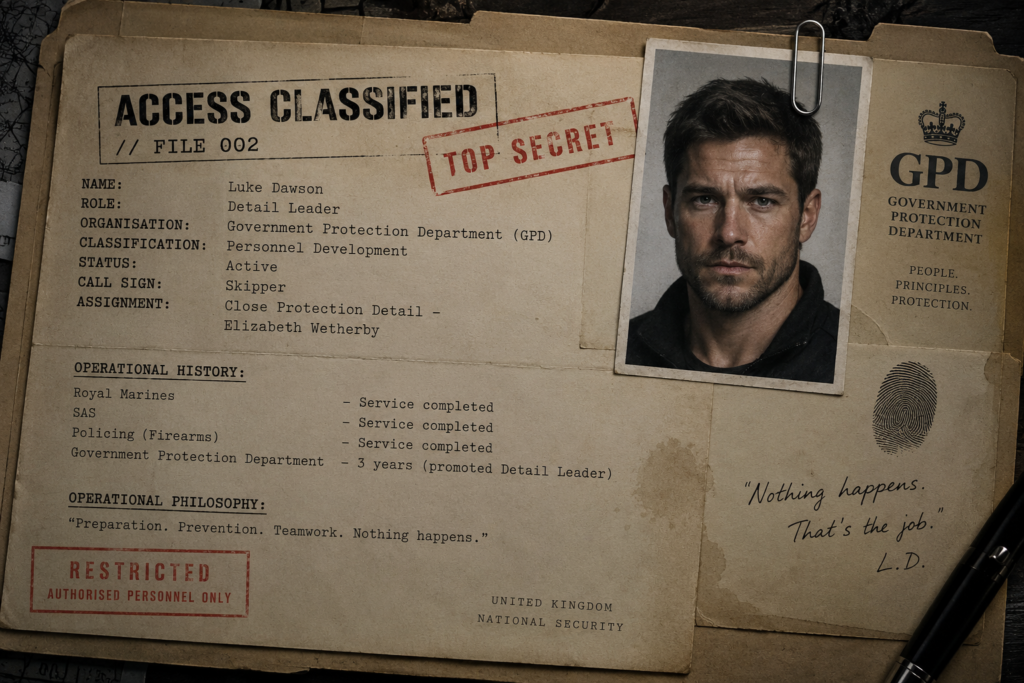
SUBJECT: Luke Dawson
CLASSIFICATION: PERSONNEL DEVELOPMENT
STATUS: ACTIVE
ASSIGNMENT: Close Protection Detail — Elizabeth Wetherby
ORGANISATION: Government Protection Department (GPD)
CALL SIGN: Skipper
There are certain characters who arrive almost fully formed.
Luke Dawson wasn’t one of them.
I knew what job I needed him to do very early in the development of The Prime Minister’s Daughter. I needed a close protection officer assigned to Lizzie Wetherby. I needed somebody exceptionally good at that job. And, considering what I intended to put the poor bastard through over three books, he was inevitably going to need a fairly serious operational background.
That created a problem.
Because it would have been incredibly easy to turn Luke Dawson into exactly the sort of thriller character I didn’t want to write.
PERSONNEL RECORD: LUKE DAWSON
Luke Dawson is 31 at the beginning of The Prime Minister’s Daughter.
Before joining the Government Protection Department, he spent ten years in the Armed Forces, serving first with the Royal Marines and later with the SAS. After leaving the military voluntarily, he moved into policing, specialist firearms and eventually close protection.
By the beginning of the novel, Luke has spent three years with GPD and is promoted to Detail Leader of the newly created protection team assigned to twenty-year-old Elizabeth ‘Lizzie’ Wetherby, the Prime Minister’s daughter.
On paper, that probably sounds like I’ve assembled every ingredient required to create an action-thriller superhero.
Former Royal Marine.
Former SAS.
Armed police officer.
Close protection specialist.
Give him a pistol, put somebody important behind him and spend the next 400 pages allowing him to shoot absolutely everybody.
Except that was precisely what I didn’t want Luke Dawson to be.
OPERATIONAL PHILOSOPHY: NOTHING HAPPENS
One of the most important things I worked out while developing Luke Dawson was his definition of a successful day.
Nothing happens.
That’s it.
Nobody shoots at Lizzie. Nobody gets close enough to hurt her. Nobody notices Luke doing anything particularly dramatic because the threat was identified, assessed and dealt with before it became an attack.
For Luke, the perfect protection operation is the boring one.
His approach is based on preparation, prevention, teamwork and professionalism. He doesn’t want to look intimidating for the sake of it. He doesn’t need everybody in the room to know he’s the hardest bastard standing in it. If he can quietly do his job without anybody paying much attention to him, that’s probably preferable.
That became one of the foundations of Luke Dawson as a character.
It also became one of the foundations of the entire GPD.
THE BODYGUARD I DIDN’T WANT TO WRITE
We’ve all seen the character.
He’s protecting somebody important, but apparently every other trained professional around him is completely useless.
The intelligence people are useless.
The police are useless.
His own protection team are mostly there to get shot.
Then our hero notices something everybody else has missed, ignores every order he’s given, grabs the principal, commandeers a car and spends the rest of the story single-handedly saving Britain.
Great fun in the right kind of story.
But it isn’t what I wanted The Prime Minister’s Daughter to be.
The Government Protection Department was built around the opposite idea.
GPD explicitly rejects the ‘lone hero’. Protection is layered. Intelligence, surveillance, advance teams, transport, close protection officers, firearms support, local police and emergency services all contribute to keeping one person alive. If one layer fails, another should already be there.
That matters enormously to Luke Dawson.
He may be the Detail Leader, but Lizzie isn’t protected by Luke.
She’s protected by a team.
Sarah Mitchell. Hannah Price. Ben Hargreaves. David Barrett. Danny Park. The drivers, advance officers and intelligence staff the reader might barely notice are part of the same operation.
Luke’s job is to make that machine work.
And if it doesn’t?
That’s where another important part of Luke comes in.
‘MY RESPONSIBILITY’
Very early in The Prime Minister’s Daughter, Catherine Ashcroft asks Luke why he wants to become a Detail Leader.
His answer isn’t rank.
It’s responsibility.
If one of his officers makes a mistake, Luke considers it his responsibility. If the protection plan fails, it’s his responsibility. And if something happens to his principal, he believes he has failed.
That exchange probably tells you more about Luke Dawson than several pages of biography could.
He’s extremely capable, but that capability comes with a flaw.
Luke takes responsibility for bloody everything.
And I mean everything.
That isn’t necessarily healthy.
Part of his military experience taught him that the greatest responsibility a leader carries is bringing as many of their people home as possible. The death of somebody under his command stayed with him even after an investigation concluded there was realistically nothing he could have done differently.
So when Luke becomes responsible for Lizzie Wetherby’s life, this isn’t just another assignment.
Failure is personal.
Which becomes rather inconvenient when people actually start trying to kill her.
WHY LUKE LEFT THE MILITARY
Another thing I didn’t want was the stereotypical former special forces character who left because he was too dangerous, too rebellious or had punched the wrong commanding officer.
Luke served ten years.
He was good at it.
And then he chose to leave.
The important distinction is that he didn’t stop believing in Britain or suddenly decide that his military service had meant nothing. He began questioning whether the work he was doing still matched the reason he’d joined in the first place.
Luke wanted to protect people.
Policing offered him another way of doing that. Close protection eventually brought together almost everything he’d learnt — planning, intelligence, firearms, driving, leadership, threat assessment and teamwork — while returning him to that basic idea of protecting rather than destroying.
That’s why GPD fits him so well.
Perhaps a little too well.
Because by the time we meet Luke Dawson, the job isn’t merely what he does.
It’s a large part of who he is.
LUKE DAWSON ISN’T THE STORY’S GUN
Don’t misunderstand me.
There is action in The Prime Minister’s Daughter.
Luke carries a firearm for a reason, and when violence happens I want it to feel dangerous, messy and consequential. The wider trilogy was deliberately designed so that violence and action serve the characters rather than becoming spectacle. Injuries matter. Decisions made under pressure matter. Pulling a trigger doesn’t magically reset everything when the chapter ends.
But Luke Dawson isn’t interesting to me because he can shoot.
He’s interesting because he knows when not to.
He’s interesting because he understands that getting Lizzie away from danger matters more than chasing the person who created it.
He’s interesting because being the leader doesn’t mean being the only competent person in the room.
And he’s interesting because underneath all that training, discipline and professional detachment is a man who has built almost his entire identity around being useful to other people.
Take that away from him and there is a much more difficult question waiting underneath.
Who is Luke Dawson when he isn’t protecting somebody?
That’s where his story gets interesting.
THEN I GAVE HIM LIZZIE WETHERBY
Of course, creating a highly disciplined protection officer wasn’t enough.
I then gave him possibly the worst principal imaginable for him.
Lizzie Wetherby is twenty years old. She’s spent much of her life having people tell her where she can go, what she can do and how she should behave because her father happens to be Prime Minister.
Luke arrives and, from Lizzie’s point of view, becomes another person trying to control her.
From Luke’s point of view, Lizzie is reckless, stubborn and apparently determined to make an already difficult job considerably harder than it needs to be.
They’re going to get on brilliantly.
Eventually.
What begins as frustration gradually becomes trust, and that relationship forces Luke to confront something no amount of military or police training has prepared him for: the possibility that there might actually be something in his life more important than the job.
His journey isn’t really about becoming a better soldier or a better protection officer.
He’s already very bloody good at those things.
It’s about discovering whether duty always has to come before everything else.
And across The Prime Minister’s Daughter trilogy, I’m going to make him work fairly hard to find the answer.
Sorry, Luke.
Actually, no.
I’m not.
ACCESS MORE CLASSIFIED FILES
Luke Dawson is only one part of the world behind The Prime Minister’s Daughter.
There is considerably more sitting inside the fictional filing cabinets — Lizzie Wetherby, the Government Protection Department, the officers surrounding Luke, the political world of Number 10 and a few people whose files might contain rather more redactions than others.
I’ll be opening more of them as we get closer to release.
If you’ve enjoyed this look behind the creation of Luke Dawson, share the post, leave a comment and tell me what you’d like to see pulled from the classified files next.
You can find more of my books, writing and everything else happening at CMeewrites.
And to find out more about The Prime Minister’s Daughter, Luke Dawson and other operations, head to the ACCESS CLASSIFIED section:
ACCESS CLASSIFIED // FILE 002 CLOSED