
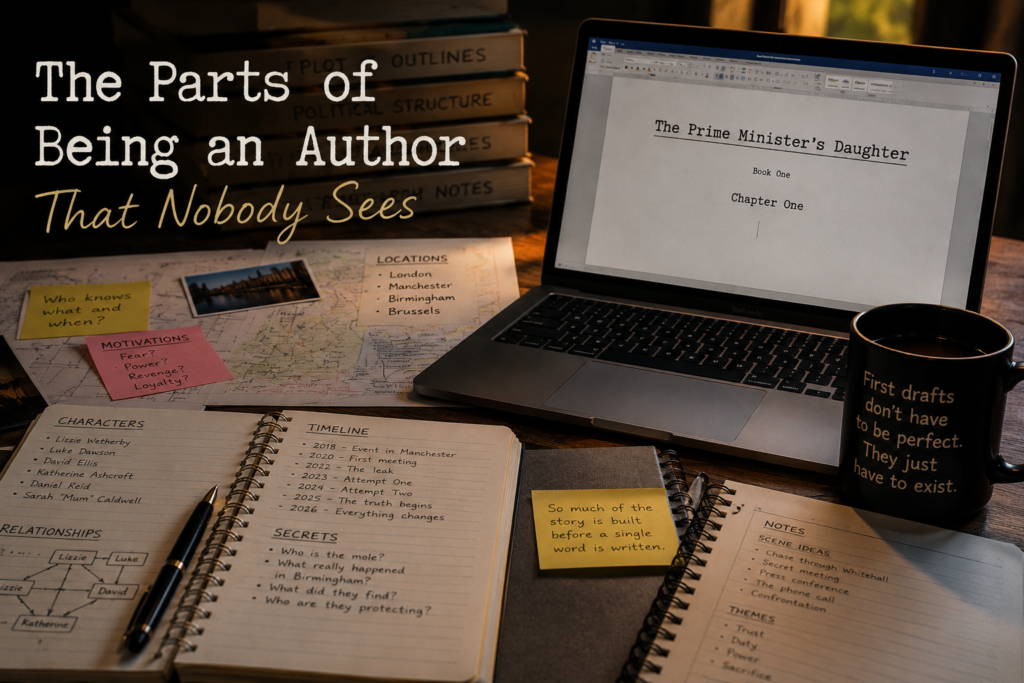
When people think about being an author, they naturally think about writing.
An idea appears, you sit down in front of a computer, open a blank document and eventually type those two words every writer spends far too long thinking about: Chapter One.
From there, the story grows until eventually there’s a finished book.
That’s the part readers see.
What they don’t necessarily see is everything that can happen before Chapter One is ever written.
And the more I’ve been planning my next project, The Prime Minister’s Daughter, the more I’ve realised just how much of being an author happens completely behind the scenes.
Not because it’s some great secret. Not because authors deserve a medal for doing it.
Simply because readers aren’t supposed to see it.
There Can Be Another Book Before the Book
The Prime Minister’s Daughter is going to be my biggest fiction project so far.
It’s a trilogy, and that immediately changes how I’ve had to approach planning it.
I’ve written before about just how different I’ve found the challenge of planning three connected novels rather than one standalone story.
But there’s another side to that planning which I hadn’t really thought about until I was already doing it.
If I added together every character bible, timeline, plot outline, background document and random collection of notes I’ve created for The Prime Minister’s Daughter, I could already have somewhere between 50,000 and 100,000 words.
Before properly writing Chapter One.
The interesting part is that readers will probably never see the vast majority of them.
And that’s exactly how it’s supposed to work.
Building People Before Introducing Them
Characters don’t begin existing when they first walk onto the page.
At least, they don’t for me.
Before I introduce somebody to a reader, I want to understand who that person is.
That can mean knowing where they grew up, what their family was like, what they’ve done professionally, who they’ve loved, who they’ve lost, what mistakes they’ve made and which experiences have shaped the person we eventually meet.
Some of that might become important to the story.
Some might get mentioned once.
Some of it might never be mentioned at all.
But knowing those things changes how I write the character.
If I know why somebody behaves a certain way, I don’t necessarily need to explain it to the reader. I can let that history influence their decisions, their relationships and even the way they speak.
The reader might never know the complete story behind that character.
Hopefully, they’ll simply believe them.
Who Knows What — And When Do They Know It?
This is one of those parts of being an author that I’d never really considered before I started writing fiction.
Stories aren’t just about what happens.
They’re also about who knows what happened.
That can become surprisingly important.
If two characters have a private conversation in Chapter Five, somebody who wasn’t there can’t suddenly know about it in Chapter Ten unless there’s a reason.
If somebody discovers something important halfway through the story, their behaviour before that moment has to reflect the fact that they don’t know it yet.
With a political thriller, that becomes even more interesting.
Different characters can have completely different pieces of the same puzzle. Some know the truth. Some know part of it. Some believe something that isn’t true at all.
As the author, I need to know the difference.
The reader doesn’t need to see the document where I’ve worked all of that out.
They just need the story to make sense.
Characters Have Histories That Might Never Reach the Page
One of my favourite parts of planning is creating the history that exists before the story begins.
A novel might start on a particular Monday morning, but the characters didn’t suddenly appear at midnight on Sunday.
They’ve already lived.
They’ve got relationships with each other. They’ve got memories. They might have known each other for years. There are conversations they’ve already had and things they already understand about one another.
That’s particularly important with The Prime Minister’s Daughter because I’m creating relationships that need to feel established from the moment we first see them.
I don’t necessarily need to explain every previous conversation or every shared experience.
In fact, doing that would probably make the book considerably worse.
I just need to know they happened.
That background gives me something to write from.
Then There Are the Tiny Details
This is where planning can become strangely specific.
How old was somebody when a particular event happened?
How long have two people known each other?
When did somebody start a particular job?
Does the timeline actually allow everything I’ve said happened to have happened?
If somebody mentions something happened six years ago, does that still fit with another detail I established somewhere else?
Individually, these things can seem tiny.
But put enough tiny details together and they create a world that feels consistent.
That’s particularly important across a trilogy.
Something mentioned almost in passing in the first book could become relevant much later. A relationship established early might completely change by the third novel.
The reader shouldn’t need to keep a spreadsheet next to them to understand any of it.
That’s my job.
Sometimes Hours of Research Become One Sentence
Research is another largely invisible part of being an author.
You can spend ages learning about something only for almost none of that information to appear in the finished book.
That isn’t necessarily because the research wasn’t useful.
Sometimes it’s useful precisely because it doesn’t all appear.
If I understand how something works, I can hopefully write about it naturally without stopping the story to explain everything I’ve just learned.
Hours of research might become a paragraph.
Sometimes it might become a sentence.
Sometimes it might simply stop me writing something that’s wrong.
The reader doesn’t need to know how long I spent researching it.
They just need to believe it when they read it.
The World Needs to Exist Beyond What the Reader Sees
I think this is probably the best way I can describe what all this planning is actually for.
A reader only ever sees a tiny window into the world of a novel.
They meet certain characters. They visit certain places. They witness particular conversations and events.
But for that window to feel real, there needs to be something beyond it.
Characters need lives outside the scenes we see.
Relationships need histories.
Decisions need motivations.
Events need consequences.
The world needs to feel as though it existed before page one and will continue existing whenever the reader isn’t looking at it.
Most of that never needs explaining.
It just needs to be there.
If You Notice the Planning, I’ve Probably Done Something Wrong
That’s perhaps the strange thing about this side of being an author.
I don’t actually want readers thinking about it while they’re reading.
I don’t want somebody halfway through The Prime Minister’s Daughter thinking about my character bibles or wondering how many versions of a timeline I created.
I want them thinking about the characters.
I want them wondering what’s going to happen next.
I want something established earlier in the story to make sense when it becomes important later.
I want characters to behave like people rather than pieces I’m moving around because the plot needs them somewhere.
If the preparation has worked, it should almost disappear.
That’s the Part of Being an Author Nobody Sees
Writing will always be the most obvious part of being an author.
Eventually, I will sit down and properly start Chapter One of The Prime Minister’s Daughter. All those characters, timelines, relationships, motivations and pieces of history will finally start becoming an actual novel.
But the story won’t really have started with Chapter One.
It will have started months earlier.
In documents readers will never see.
In character histories that might never be mentioned.
In research that could eventually become a single line.
In timelines created purely to make sure everything fits together.
And I wouldn’t expect a reader to see any of it.
That’s the whole point.
Because all of those thousands of words aren’t the story.
They’re the scaffolding that allows me to build one.
Come Behind the Scenes With Me
If you’re a reader, I’d love to know whether you ever think about what might exist behind a novel before you read Chapter One. And if you’re a writer, how much work do you do before you actually start writing?
Let me know in the comments and share this post with somebody who might enjoy seeing a little more of what happens behind the scenes of being an author.
You can also find my books, latest blog posts and everything I’m currently working on at CMeewrites