
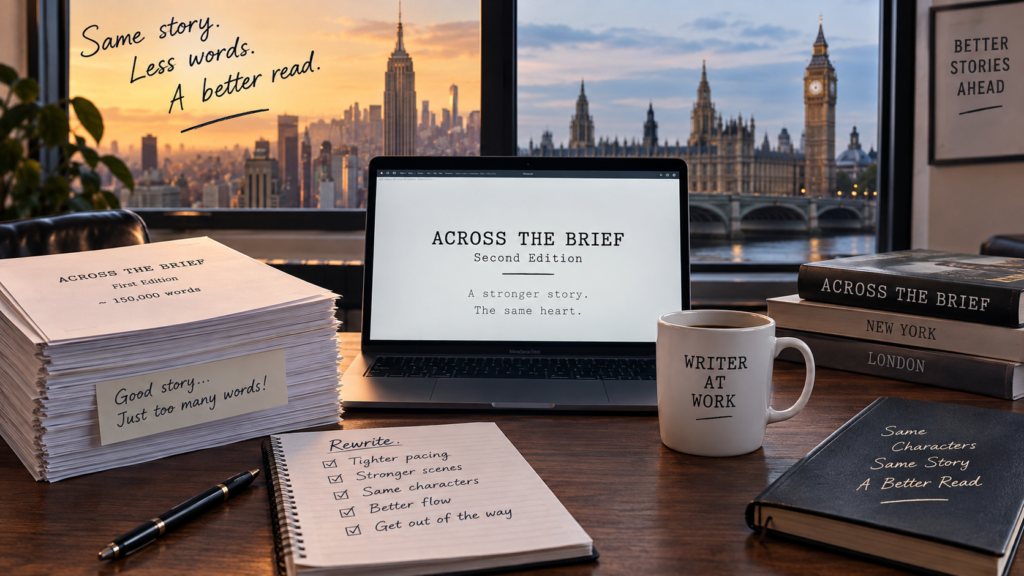
I’m rewriting my first novel.
That sentence probably sounds much more dramatic than it actually is.
Across the Brief was only published in November 2025. It hasn’t been sitting on a shelf for twenty years while I’ve occasionally looked at it and thought, One day, I’m going back to sort you out.
It hasn’t even been a year.
But Across the Brief was my first attempt at writing fiction, and having written considerably more fiction since then, I can now see exactly where I was learning as I went along.
The important thing is that I still think it’s a very good story.
If I didn’t, I wouldn’t be doing this.
The problem isn’t the story.
The problem is that I overwrote it.
Quite spectacularly, actually.
It’s a bloody doorstop
The First Edition of Across the Brief is roughly 150,000 words. The original manuscript comes in at just over 151,000.
That is a lot of words.
There are certainly stories that need 150,000 words. I don’t think Across the Brief is one of them.
At its heart, it’s the story of Megan Porter and Tom Bennett, two lawyers on opposite sides of the Atlantic whose lives collide almost accidentally online.
Megan is building her career in New York. Tom is a criminal barrister in London. A Facebook friend request that probably shouldn’t mean very much gradually becomes something neither of them can ignore.
Their careers matter. The distance matters. Tom being a wheelchair user is part of his life and affects some of the practical realities of their relationship. They are two people with established lives in different countries trying to work out whether an unexpected connection can become something much bigger.
There’s plenty in there.
There just isn’t 150,000 words’ worth of it.
And the trouble with making a story longer than it needs to be is that eventually the length starts hiding the story.
I sometimes get bored reading it.
And I wrote the bloody thing.
That’s probably a fairly good indication that something needs doing.
The story isn’t boring
This is the distinction that really matters to me.
I don’t think Across the Brief is a boring story.
I still like Megan and Tom. I still like the slightly ridiculous simplicity of how everything begins. I still like putting Megan’s corporate legal world in New York against Tom’s life in criminal law in London. I like the humour between them, the professional pressures, the complications of a long-distance relationship and the way something that begins through a screen gradually changes both of their lives.
That is why I want to rewrite it.
What sometimes makes the First Edition feel boring is how long I take to tell you everything.
A character can have an emotional reaction, think about the emotional reaction, explain the emotional reaction and then have a conversation in which we effectively cover the emotional reaction again.
The reader understood it the first time.
I just hadn’t yet learned to trust that.
There are scenes that continue after they’ve done their job. Conversations that could finish several exchanges earlier. Pieces of information that come back when the reader already knows them. Moments that take three pages when they might be stronger in one.
None of that means the underlying story doesn’t work.
It means I need to get out of its way.
I actually had plenty of experience writing long-form work
One thing I don’t want to pretend is that I sat down to write Across the Brief having never written anything substantial before.
By then, I’d been writing CMBoxing articles for years, and some of those can get pretty long.
I’d written my nonfiction book about Hulk Hogan.
And before any of that, I’d been through university. I have a law degree and completed the Legal Practice Course. I knew all about essays, assignments and finding enough words to fill a required word count.
In hindsight, that might have been part of the problem.
Because when I look back at the First Edition of Across the Brief, there are times when I think I approached fiction as though I was still writing a university essay.
How many words can I fill before I get bored?
At university, if somebody asks you for 3,000 words, handing in 1,200 and saying, “That’s all I needed” probably isn’t going to end particularly well.
So you learn to develop the argument. Explain it. Support it. Come at it from another direction. Make absolutely certain the person reading it understands the point you’re making.
Those instincts can be useful.
They can also be disastrous when two characters are having a conversation.
Fiction doesn’t reward you for proving that you can keep writing.
Sometimes the best thing you can do for a scene is stop.
That was the instinct I didn’t have yet.
I was learning how to write fiction while writing it
Writing boxing articles taught me plenty about writing.
Writing nonfiction taught me plenty about structure, research and keeping somebody reading over a longer piece.
University certainly taught me how to construct an argument.
But fiction is its own thing.
When I wrote Across the Brief, I was learning how scenes work while writing the scenes. I was learning how much dialogue was enough while writing conversations that were sometimes far too long. I was learning when to explain something and when to trust the reader to understand it without me stepping in.
Most importantly, I was learning when a scene was finished.
That sounds obvious now.
It wasn’t then.
Since publishing Across the Brief, I’ve written a lot more fiction. That doesn’t mean I suddenly think I’m God’s gift to literature. It means I’ve had considerably more practice.
And when I go back to my first novel now, I can see the difference.
This isn’t a 60,000-word deletion exercise
I expect the Second Edition to end up somewhere around 90,000 words.
Considering the First Edition is roughly 150,000, that means there could be around 60,000 words disappearing.
That sounds brutal when you put it like that.
But I’m not opening the manuscript with a target saying, “Right, I need to murder 60,000 words.”
If the best version is 85,000, fine.
If it’s 95,000, fine.
If an important moment needs more space than I gave it the first time, I’ll give it more space.
This is about pacing, not arithmetic.
Some scenes can probably disappear completely. Others can be combined. Some conversations can be much shorter. There are explanations the Second Edition simply won’t need because the reader already knows the information.
Equally, there may be moments where the First Edition actually moved too quickly and I now want to slow down.
The aim isn’t to make Across the Brief shorter.
The aim is to make it better.
I just strongly suspect that making it better will also make it considerably shorter.
I’m rewriting it, not editing it
This is probably the biggest difference between what I’m doing and a normal revised edition.
I’m not opening the First Edition and going through it with Track Changes.
I’m starting again from page one.
The existing novel is the foundation. It tells me what happens, who these people are, how their relationships develop and where the story ultimately goes.
But the actual writing of the Second Edition will be new.
A scene might still happen but be completely reconstructed.
Two scenes might become one.
Something might move.
A chapter might end much earlier.
A quiet character moment might survive almost exactly in spirit because it earns its place.
An important emotional moment might actually become longer because I rushed it the first time.
That’s why I don’t really think a line edit would solve the problem.
There’s no point repainting the room if I’m planning to knock the wall down.
What isn’t changing?
This is still Across the Brief.
I’m not using the Second Edition as an excuse to replace the original story with a completely different one.
Megan is still Megan.
Tom is still Tom.
Their relationship is still the heart of the novel.
The major events, relationships and emotional identity of the book will remain recognisable.
I also don’t want to change things simply so I can point at them and say, “Look! It’s different!”
If something worked in the First Edition, there’s no reason to throw it away.
Keep what works.
Rewrite what can work better.
Remove what doesn’t need to be there.
Then move on.
And no, I’m not embarrassed by the First Edition
I want to make this clear because announcing that you’re rewriting your first novel could easily sound like you’re trying to disown it.
I’m not.
I’m glad I wrote Across the Brief.
I’m glad I published it.
And I’m especially grateful to the people who read and enjoyed the First Edition, because I’m certainly not now telling them they were wrong to enjoy it.
The story worked.
I just think I made readers work harder to get through it than they needed to.
The First Edition is also a record of me learning how to write fiction.
You can watch videos about writing. You can read books about writing. You can study structure, dialogue, character development and pacing.
Eventually, though, you have to write the novel.
And I did.
A very, very long one.
Without that version of Across the Brief, I wouldn’t have learned everything that came from writing it.
The strange thing is, it isn’t even an old book
This might be the oddest part of the whole thing.
Across the Brief came out in November 2025.
I’m writing this in 2026.
Hardly an archaeological expedition.
But the amount of fiction I’ve written since starting that first novel means I can already see things differently.
I understand pacing better.
I trust dialogue more.
I’m more willing to end a scene when it has done what it came to do.
I’m less frightened of leaving something unsaid.
And I’m much more willing to trust the reader.
There are places where Current Me would quite happily tell First-Novel Me that he could have stopped three pages ago.
That’s progress.
Getting out of the story’s way
That is really what the Second Edition is about.
I’m not trying to rescue a story I no longer believe in.
I’m going back because I do believe in it.
I want Megan and Tom’s relationship to move with more confidence. I want the important moments to land harder because they aren’t surrounded by unnecessary repetition. I want the quieter moments to have room when they deserve it, rather than simply being part of another enormous chapter.
I want somebody reading the Second Edition to experience the story without feeling as though they’re wading through it.
It will still be Across the Brief.
Just tighter.
More confident.
Better paced.
And, I hope, better written.
It may also be slightly less dangerous if you accidentally drop the paperback on your foot.
What happens to the First Edition?
Nothing.
The original version of Across the Brief will remain available.
The rewritten novel will be published separately as the Second Edition.
I’m not treating this like a conventional new-book launch, and I’m not going to spend months shouting COMING SOON every five minutes until everybody mutes me.
This is something I want to document properly in the Writing Room because I think the process itself is interesting.
How do you take the first novel you ever wrote, strip away tens of thousands of unnecessary words and rebuild it using everything you’ve learned since?
I’m about to find out.
Come along for the rewrite
I’ll share more from the rewrite in the Writing Room as it develops — what changes, what survives, what gets combined and which pieces make me wonder what First-Novel Chris was thinking.
If you read the original Across the Brief, I’d genuinely love to know what you remember most about Megan and Tom and their story.
And if you’ve ever gone back to something you created and realised you could now do it much better, tell me about that too.
Share your thoughts in the comments, and have a look around CMeewrites for my books, Writing Room updates and everything else I’m currently working on.
The First Edition told the story.
Now I want to see how well I can tell it the second time.