
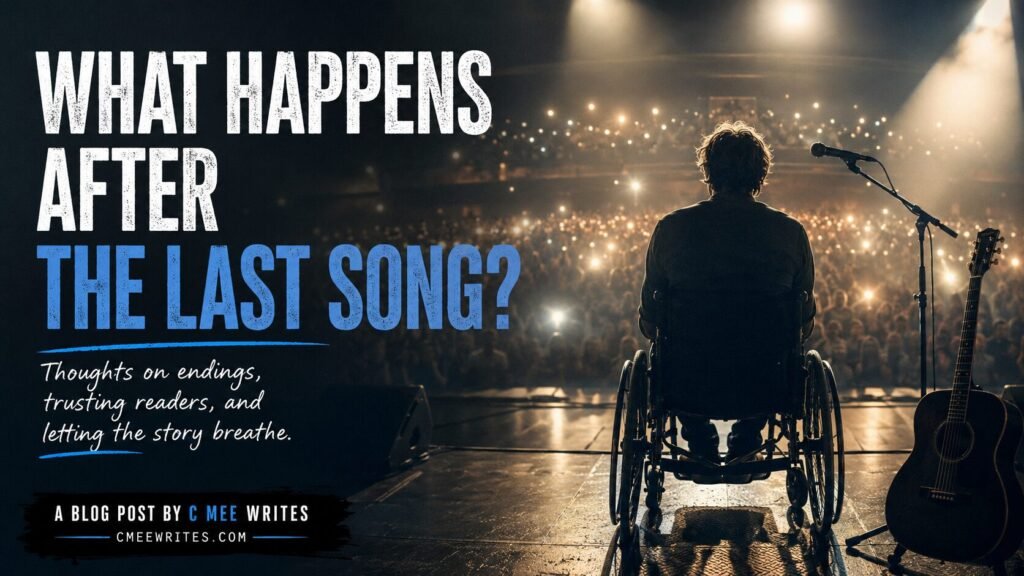
One of the questions writers get asked more than almost any other is:
“What happened after the ending?”
I’ve already had that question about This Time Around.
“What happens to Ben Carter after the final page?”
The honest answer is incredibly simple.
I don’t know.
And that’s entirely intentional.
Some people might find that a strange answer coming from the person who wrote the book, but for me it’s always been the only answer that felt right. Because This Time Around was never about what Ben does next. It was about whether he could finally learn how to live again after spending fifteen years simply surviving.
Once that story reached its destination, I closed the book.
This Was Never A Comeback Story
One of the things I was most determined to avoid while writing This Time Around was turning it into a traditional comeback story.
Yes, Ben used to front a band called Midnight Arcade. Yes, they were on the verge of something special before the crash changed everything.
But this book was never about getting the band back together.
It wasn’t about becoming famous again.
It wasn’t about selling out arenas or topping the charts.
It wasn’t even really about music.
Music is simply the language Ben understands best.
At its heart, this novel is about grief, survivor’s guilt, disability, chronic pain, and the slow, often frustrating process of accepting that your life can still have value even when it looks nothing like the one you thought you were going to have. Those themes define Ben’s journey throughout the novel.
Once Ben reaches that emotional destination, anything that happens afterwards almost becomes a different story entirely.
Not because it isn’t interesting.
But because it isn’t this story.
I Like Endings That Trust The Reader
I’ve always loved books that leave a little space for the reader.
Not every question needs answering.
Real life doesn’t tie everything up with a neat little bow, so I’m not convinced every novel has to either.
Some readers might imagine Ben continues performing.
Others might picture him disappearing back into quieter venues.
Someone else might imagine he never sings publicly again.
Every one of those interpretations is valid because, by the time you reach the final page, you’ve spent hundreds of pages getting to know him.
You know the man.
You understand the journey.
You don’t need me to tell you every step he takes afterwards.
In many ways, I think that’s more satisfying than giving readers a checklist of what every character is doing five years later.
Why I Didn’t Write An Epilogue
At one point I briefly wondered whether I should include an epilogue.
You know the sort of thing.
“Five years later…”
Here’s where everybody lives.
Here’s what everybody’s doing.
Here’s how everything turned out.
The more I thought about it, the more I realised it would actually weaken the ending I’d spent an entire novel building towards.
The final chapter already says everything I wanted it to say.
Adding another chapter explaining everybody’s future would almost feel like I didn’t trust readers to sit with the ending for themselves.
Sometimes less really is more.
Once the final image arrives, I genuinely believe readers already know everything they need to know.
It’s Never Been About The Next Chapter
Without spoiling anything for people who haven’t read the novel yet, the final chapter isn’t important because of what happens next.
It’s important because of what that final performance represents.
From the very first page, Ben has been carrying fifteen years’ worth of grief, guilt and silence.
Every chapter moves him, often reluctantly, towards one emotional destination.
That final performance isn’t there to launch another adventure.
It isn’t setting up a sequel.
It’s the moment the entire novel has been travelling towards from the opening page.
Once that moment arrives, the story has reached its natural conclusion.
Anything beyond that would simply be another book.
Now The Story Belongs To You
One of my favourite things about publishing a novel is that, eventually, it stops belonging solely to the person who wrote it.
Every reader brings something different.
Different experiences.
Different losses.
Different hopes.
Different interpretations.
That’s why I’m genuinely interested to hear what people think happens after the final page.
Not because there’s a right answer.
But because there isn’t one.
Your version of Ben’s future may be completely different to mine.
And I honestly think that’s one of the nicest things about fiction.
Once you close the book, the story continues in your imagination.
Exactly where it should.
Over To You…
If you’ve finished This Time Around, I’d genuinely love to know what you thought of the ending—but please keep it spoiler-free for anyone who hasn’t read it yet.
Leave a comment below and tell me what you believe happens after the last song.
If you enjoyed the novel, I’d also really appreciate it if you could leave an honest review on Amazon. Reviews make a huge difference for independent authors and help new readers discover books they might otherwise never find.
You can also explore more behind-the-scenes articles, writing blogs and book updates here on CMeewrites There are plenty more stories waiting for you.