
Let me be brutally honest.
I hate editing.
Not because it isn’t important — it absolutely is. Editing is where the manuscript sharpens up, where pacing improves, where dialogue tightens. But emotionally? Editing can feel brutal.
You spend weeks — sometimes months — writing a story. You live inside it. You care about it. Then you have to go back and admit that certain chapters don’t land, bits of dialogue feel flat, or that scene you loved just doesn’t quite work.
That’s the part no one romanticises.
The trick with editing without losing voice is remembering this:
Use a scalpel. Not a hacksaw.
Editing Without Losing Voice Means Not Tearing Everything Apart
One of the biggest mistakes writers make is assuming that editing means dramatic change.
It doesn’t.
Serious editing isn’t demolition. It’s precision.
If you rip your manuscript to pieces the second you finish it, you’ll often end up rewriting the whole thing. Then you edit that. Then you rewrite again. Round and round you go.
I’ve done it. It’s exhausting.
And here’s the real danger: the more times you rebuild a story from scratch, the further you drift from the emotional headspace you had when you first wrote it.
That’s how voice disappears.
Editing without losing voice isn’t about how much you change. It’s about how carefully you change it.
Never Edit on the Same Day
This is the bit people ignore.
Don’t edit on the same day you finish the draft.
You type “The End” and you feel something — relief, pride, doubt, fatigue. Whatever it is, you’re still too close to the story.
That’s the worst moment to start cutting.
When you edit immediately, you’re either overly protective or overly critical. You’ll defend weak sections because you’re attached. Or you’ll slash good material because you’re tired of looking at it.
Neither leads to editing without losing voice.
Give it a couple of days. Let your brain reset. Step away. Do something else.
Distance creates clarity.
When you return, you’re not reacting emotionally. You’re refining deliberately.
Now, full honesty — I don’t always follow this rule. And when I don’t, that’s usually when the manuscript turns into another full rewrite from the beginning. That’s when the vicious circle starts.
Time away protects the original emotional intent.
Editing isn’t just about skill. It’s about timing.
I Edit As I Go
This won’t work for everyone, but it works for me.
I edit as I write.
Not obsessively. Not chasing perfection. But if a paragraph feels clunky, I smooth it. If dialogue sounds unnatural, I tweak it there and then.
Why?
Because the emotional intent is still fresh.
When I reach the end of the manuscript, I’m not staring at a chaotic first draft. I’m looking at something that already sounds like me.
That makes editing without losing voice much easier, because I’m not trying to rediscover tone months later.
The core is already intact.
The Red Highlighter Test
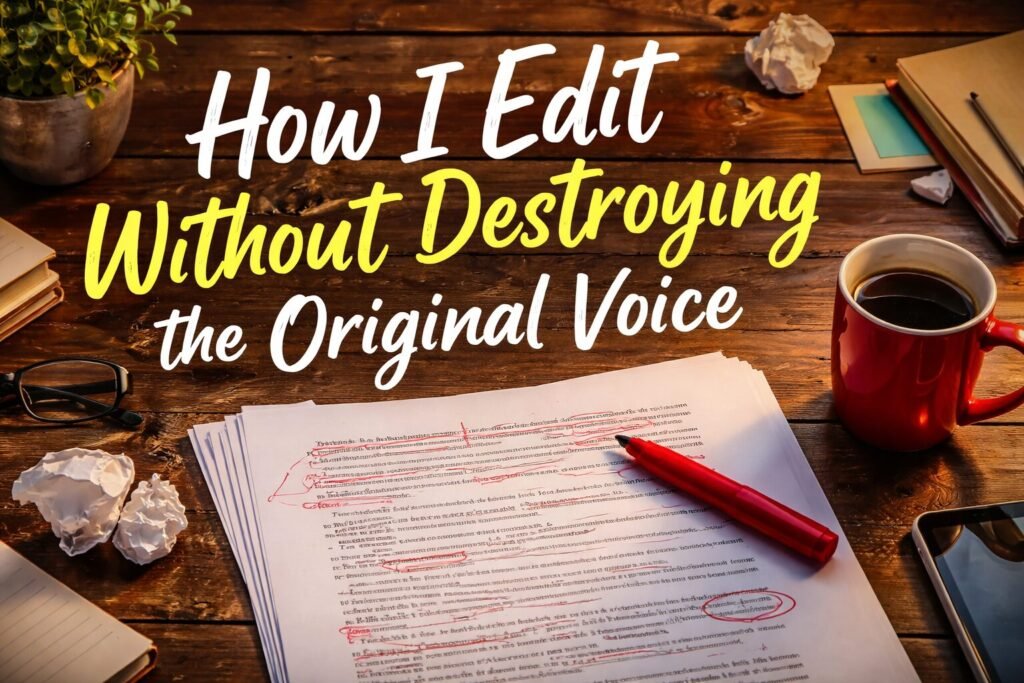
When the manuscript is finished — and I’ve given it space — I print it out.
Yes, properly print it.
Then I grab a red highlighter.
It does feel a bit like being back at school getting your English homework marked. But it works.
I read it as a reader.
Not as a perfectionist. Not as someone trying to prove they can “fix” everything. Just as someone asking:
- Does this land?
- Does this sound like the character?
- Does this carry the emotional weight it’s supposed to?
If something doesn’t quite hit, I circle it.
Here’s the key part:
I don’t automatically rewrite whole scenes.
Sometimes I polish two sentences.
That’s enough.
Editing without losing voice often means realising the structure is fine — it just needs tightening. Most chapters don’t need rebuilding. They need sharpening.
Knowing What Not to Change
This might be the most important part of the whole process.
Editing isn’t just about spotting weaknesses. It’s about recognising what works — and leaving it alone.
If a piece of dialogue has energy, keep it.
If a sentence has rhythm and personality, don’t sterilise it just because it isn’t technically perfect.
Voice lives in the rough edges.
When you chase technical perfection over emotional truth, you end up with something clean… but flat.
Editing without losing voice means protecting:
- Character rhythm
- Emotional intent
- Natural speech patterns
- Your own narrative personality
Sometimes the “flaw” is actually flavour.
Tweaking, Not Rewriting
Most manuscripts don’t need structural surgery.
They need:
- Cleaner transitions
- Sharper dialogue beats
- Slight pacing adjustments
- Tighter sentences
That’s tweaking.
The mistake a lot of writers make is believing that good editing must look dramatic. It doesn’t.
The best editing is often invisible.
Readers shouldn’t feel like the book has been engineered. They should feel like it flows.
And flow comes from protecting voice while refining clarity.
Editing Without Losing Voice Is About Trust
At the heart of all this is trust.
You have to trust that your first draft contained something real. Something honest. Something worth protecting.
If you treat every draft like it’s broken, you’ll eventually start writing cautiously. And cautious writing kills voice faster than bad grammar ever could.
Editing without losing voice is about refinement, not reinvention.
Polish the edges. Strengthen the weak spots. Leave the soul alone.
Final Thought
Editing is necessary. You can’t skip it.
But you don’t have to destroy what made the story yours in the first place.
Use a scalpel.
Give yourself distance.
Tweak instead of tear apart.
And remember — editing without losing voice is just as much about what you don’t change as what you do.
Let’s Talk
How do you approach editing without losing voice?
Do you dive straight back in, or do you give yourself space before revising?
Drop a comment and share your process. And if you want more honest, no-nonsense writing insights, head over to CMeewrites and explore The Writing Room.
Let’s build better stories — without sanding off the soul.