
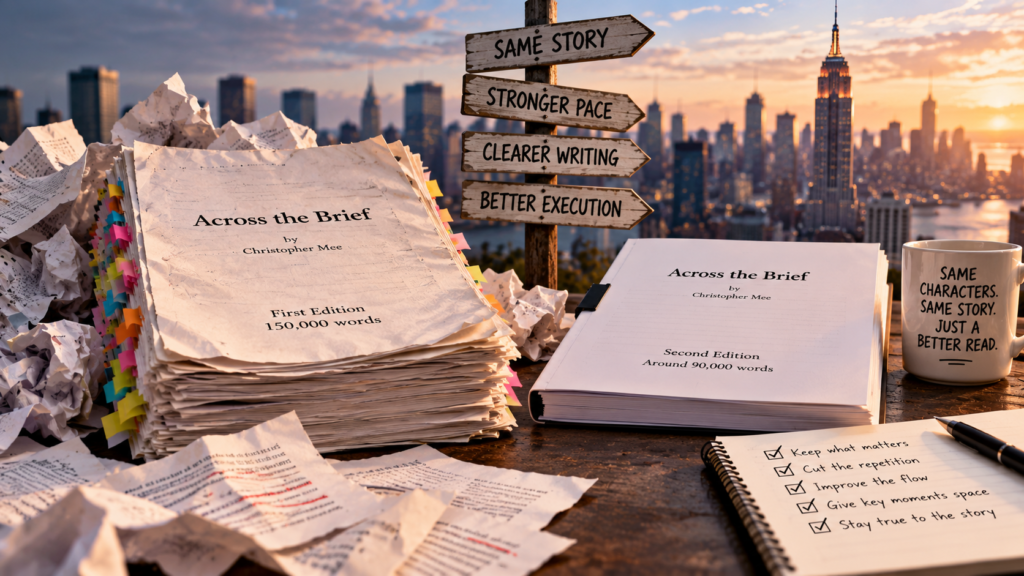
Rewriting a novel is a strange way to write.
You’re sitting there trying to be creative, exactly as you would when writing any other book, except there’s one fairly major problem.
You already know what happens.
Not only do you know what happens, but there’s a 150,000-word book sitting beside you telling you what happens, when it happens, who it happens to and, occasionally, taking about four times as long as necessary to tell you about it.
Welcome back to Across the Brief.
I’ve written before about why I decided to rewrite my first novel:
And I’ve also written about something I discovered pretty quickly once I actually started doing it: rewriting a novel can be harder than writing one for the first time.
But there’s another part of this process that I hadn’t really thought about until I was properly into the Second Edition.
Sometimes, rewriting a novel feels a bit like trying to write with the creative part of your brain under supervision.
I Can’t Just Make It Up Anymore
When I’m writing a completely new novel, I’ve got a plan. I know where the story is going, I know roughly what needs to happen in each chapter and I know where the characters need to end up.
But things change.
A conversation might go somewhere I hadn’t expected. A minor character might become more interesting than I originally intended. A scene I thought would take 2,000 words might suddenly need 3,500.
That’s part of writing fiction.
Sometimes the best things happen because you stop following the plan quite so rigidly and let the story breathe.
Rewriting Across the Brief is different.
I still have that freedom, but there’s always another question sitting behind it:
Does this still belong in Across the Brief?
That matters because I’m not trying to replace the original story with a different one that happens to have the same title and characters.
I like the story.
That’s the whole bloody reason I’m doing this.
If I thought the story itself was rubbish, I wouldn’t be spending months rewriting it. I’d leave it alone and write something else.
The problem with the First Edition isn’t the story.
It’s how long I took to tell it.
Cut the Time, Not the Story
This has become probably the simplest way I can explain what I’m trying to achieve with the Second Edition:
Don’t cut the story in half. Cut the amount of time it takes to tell the story in half.
The First Edition is roughly 150,000 words.
It is, to use the technical publishing term, a bloody doorstop.
The Second Edition is going to be considerably shorter, but that doesn’t mean I can simply go through every chapter and remove 40 per cent of it.
That isn’t rewriting a novel. That’s attacking it with a pair of scissors.
The word count needs to come down because the writing is tighter.
If two scenes are effectively doing the same job, perhaps they become one.
If a character has already explained something, I probably don’t need another character explaining it again 20 pages later.
If I’ve spent three paragraphs telling you what somebody is thinking when one good paragraph would do it, there’s an obvious saving.
And if a scene has made its point and I’m still writing?
Chris, mate. Stop.
That’s where a huge amount of the First Edition’s excess comes from.
But Some Things Actually Need More Space
Here’s where rewriting a novel gets slightly more complicated.
Not everything needs to be shorter.
There have already been moments where I’ve looked at the original material and thought the exact opposite.
I’ve rushed this.
That scene needs another beat. That conversation deserves more room. That emotional moment would work better if I stopped worrying about getting to the next plot point and actually let the characters experience what has just happened.
So yes, I’m trying to remove tens of thousands of words from Across the Brief.
And yes, sometimes the correct way to do that is apparently to write more words.
Nobody said this had to make sense.
The important thing is that every scene gets the space it deserves rather than an arbitrary percentage of whatever it had before.
If a scene works better at 3,000 words than 2,000, it can have 3,000.
I’ll find those thousand words somewhere else.
There are plenty available.
Trust me.
The First Edition Is Both the Problem and the Rulebook
This might be the strangest part of rewriting a novel that has already been published.
The First Edition is the thing I’m trying to improve.
It is also my reference material.
I can be halfway through rewriting a scene and have a new idea that I really like. In a new novel, I could probably just run with it.
Here, I have to think about what that change does 100 pages later.
Does it alter what somebody knows?
Does it change a relationship too early?
Does it contradict something that happens later?
Have I accidentally removed a seemingly insignificant detail that turns out to matter?
Or have I just created a brilliant new idea that requires me to rewrite half the bloody book around it?
That last one is particularly dangerous.
Because I’m not trying to create Across the Brief: Inspired by Across the Brief.
The Second Edition can absolutely improve things. Scenes can move. Conversations can change completely. Weak material can disappear. Something important that I rushed the first time can be expanded.
But Tom still needs to be Tom. Megan still needs to be Megan. Their story still needs to be their story.
Otherwise, what exactly am I rewriting?
I Don’t Want the Calorie-Controlled Edition
There is another danger at the opposite end of all this.
I could become obsessed with cutting.
Once you start watching the word count come down, I can see how easily that could happen.
Suddenly every paragraph is 200 calories and carbohydrates are banned after Chapter 12.
Before you know it, I’ve produced:
Across the Brief: The Calorie-Controlled Edition.
Same basic ingredients. Half the portion. Nobody satisfied afterwards.
That isn’t what I want either.
There’s a difference between a novel being leaner and a novel being starved.
The quieter moments matter. Character conversations matter. Sometimes a scene doesn’t need a huge plot revelation to justify existing. Sometimes two people talking tells you something important about who they are and why you should care about them.
The trick is recognising the difference between a quiet scene that earns its place and 2,000 words of me refusing to get to the bloody point.
I suspect I’m considerably better at recognising that difference now than I was when I wrote my first novel.
At least I bloody hope so.
Rewriting a Novel Means Arguing With Yourself
That’s probably what this entire process comes down to.
I’m arguing with the bloke who wrote Across the Brief the first time.
Sometimes I think he had a really good idea.
Sometimes I think he needed an editor standing behind him saying, “Yes, Chris, we understood that the first time.”
Occasionally I wonder why he thought anybody needed quite that much information.
Unfortunately, he was me.
And despite all the jokes, I don’t want to treat the First Edition as something embarrassing that needs to be erased.
It was my first attempt at writing fiction. I finished it. I published it. More importantly, underneath all the excess, I still believe there’s a bloody good story in there.
The Second Edition is about letting that story come through more clearly.
Not replacing it.
Not shrinking it until there’s nothing left.
And definitely not putting it on a diet until Tom and Megan are surviving on lettuce.
Just telling the same story better.
What Would You Keep?
If you’ve ever gone back to something you created years ago, I’d genuinely love to know how you approached it.
Would you preserve it as much as possible? Would you rip it apart and rebuild it? And where would you draw the line between improving the thing you originally created and turning it into something completely different?
Share your thoughts in the comments.
And if you want to follow the Second Edition of Across the Brief as I continue rewriting it — along with my other books, writing updates and whatever else I end up talking about — have a look around CMeewrites.
There’s plenty more to come.