
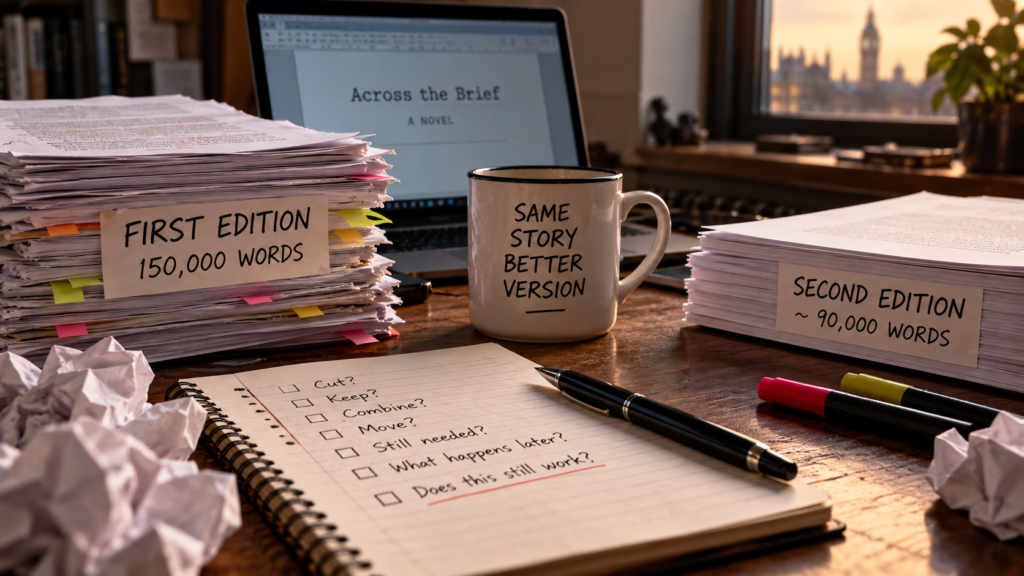
I thought rewriting a novel was going to be easier than writing one from scratch.
There. I’ve admitted it.
When I decided to go back to Across the Brief and create a completely rewritten Second Edition, I knew it wasn’t going to be a quick edit. I talked about why I was doing it in my previous Writing Room post:
The First Edition is around 150,000 words. It’s a bloody doorstop.
More importantly, it’s massively overwritten. The pacing suffers because of it, information gets repeated and there are plenty of places where I take far too long to get somewhere when the story itself doesn’t actually need that much space.
I knew all of that before I started.
What I hadn’t quite appreciated was that rewriting a novel might actually be harder than writing the bloody thing in the first place.
Because in my head, I had one enormous advantage.
I already knew the story.
Surely Knowing the Story Makes It Easier?
That was my thinking.
If I sit down tomorrow and start writing a completely new novel, there are hundreds of things I don’t know yet.
I might know my main characters. I’ll probably have the basic plot. I’ll know some of the major turning points and, these days at least, I’ll usually have a decent idea of where I’m going.
But I don’t really know the book until I’ve written it.
I don’t know exactly how a character is going to react when something goes wrong. I don’t always know which relationships will become more important than I expected. I don’t know whether a small moment I’m writing in Chapter Four will suddenly become incredibly useful in Chapter Twenty-Five.
Some of that only comes from spending 90,000 words with these people.
With Across the Brief, I don’t have that problem.
I know Megan.
I know Tom.
I know their relationship. I know their families and careers. I know the major emotional moments and the turning points. I know where the story begins, where it ends and everything these characters have to go through in between.
Most importantly, I know what I want the reader to feel.
Those are all things you normally have to discover while writing a novel.
I’ve already discovered them.
Surely that makes the Second Edition easier?
Well…
I Thought I’d Basically Be Taking a Red Pen to It
Despite repeatedly saying that this would be a complete rewrite, I don’t think my brain had entirely accepted what complete rewrite actually meant.
I had this wonderfully simple idea of how the process would work.
Open the First Edition.
Read a scene.
Keep that.
Cut this.
Combine those two.
That conversation goes on forever, so shorten it.
That chapter doesn’t really do enough to justify existing, so get rid of it.
Do that enough times and eventually my 150,000-word monster becomes a much tighter novel somewhere around 90,000 words.
Lovely.
Except that’s not really rewriting a novel.
That’s editing one.
What I’m actually doing feels much closer to writing an entirely new novel while the old one sits beside me saying:
Don’t fuck this up.
And that’s a completely different experience.
The Problem Is That I Still Like the Story
This whole thing would probably be much easier if I thought Across the Brief was simply a bad novel.
If I hated the characters, hated the plot and thought the whole thing was a disaster, I could tear it apart without worrying about what I was losing.
But that’s not why I’m rewriting it.
I still think it’s a very good story.
That’s precisely why I’m willing to go back and do all this again.
The problem isn’t the story.
The problem is how I told it.
The First Edition was my first attempt at writing fiction, and looking back at it now, you can almost see me learning how to write a novel while I’m writing the novel.
I repeat information because I clearly didn’t trust the reader to remember it.
I establish something and then establish it again.
I sometimes show what a character is feeling perfectly well through a scene and then explain the exact same emotion afterwards, just in case you somehow missed it.
And nowhere is that more obvious than at the beginning.
Megan and Tom Don’t Need Quite That Much Help
The early part of Across the Brief has an important job to do.
We need to understand Megan’s life before Tom.
We need to understand how controlled her world is, how much of her identity is wrapped up in her career and why this bloke working in the London office suddenly becoming part of her day actually matters.
We need to understand Tom too.
His career. His personality. His life before Megan. Why this unexpected connection means something to him as well.
And, obviously, we need enough time with the two of them for their relationship to feel genuine.
The problem is that the First Edition doesn’t always know when it has done enough.
It establishes something.
Then reinforces it.
Then gives it another scene.
Then possibly wanders back a chapter later just to make absolutely bloody certain you’ve got the message.
That’s where writing the Second Edition gets much more complicated than simply cutting the bits I don’t like.
Because the question isn’t:
Do I need this scene?
It’s:
What does this scene achieve, and can I achieve the same thing more effectively somewhere else?
That’s a much harder question.
How Much Can I Remove Before I Remove the Point?
This might be the biggest challenge with rewriting a novel.
It’s easy to identify repetition.
It’s much harder to work out exactly how much you can remove while preserving the emotional effect.
Imagine I’ve got four scenes in the First Edition gradually establishing Megan and Tom becoming part of each other’s daily lives.
Maybe I can do the same job in two.
Brilliant.
The pacing improves, the story moves faster and I’ve probably removed a couple of thousand unnecessary words.
But what if I reduce those four scenes to one?
Have I made the novel tighter?
Or have I just rushed the relationship?
Because there’s a point where economical storytelling stops being economical and starts becoming thin.
If Megan and Tom’s relationship is going to matter later — and it obviously does — readers need enough time with them to care about it.
I can’t just look at the word count and start swinging an axe.
That’s why the roughly 90,000-word target for the Second Edition is exactly that: a target.
I’m not trying to find 60,000 words to delete because I’ve decided the book must be 60,000 words shorter.
I’m trying to tell the same story properly.
If doing that naturally removes 60,000 words, fantastic.
If an important moment needs more room than it got in the First Edition, then it gets more room.
The story comes first.
Every Cut Has Consequences
This is the other thing I hadn’t really considered.
Nothing in a novel exists completely on its own.
I can read a scene from the First Edition and immediately think:
That’s going.
Then I have to stop myself.
Because what happens if something in that apparently unnecessary scene matters 50,000 words later?
Does it establish something about Megan that explains a later decision?
Does Tom learn something there that he needs to know later?
Does it change their relationship in some small way?
Does somebody say something that seems completely insignificant at the time but becomes important several chapters down the line?
When you’re rewriting a novel, deleting one scene can potentially affect another ten.
That’s why I’ve started thinking of the First Edition almost as source material.
I’m not trying to polish it.
I’m looking at what happens, why it happens, what each scene accomplishes and what later parts of the story depend on it.
Once I know that, I can ask the question that actually matters:
How would I write this now?
Sometimes the answer might be surprisingly similar.
Sometimes three scenes might become one.
Sometimes an entire chapter might disappear.
And occasionally I might discover that something I rushed the first time actually deserves more space in the Second Edition.
That’s the strange thing about trying to make the novel shorter.
Not everything needs to be shorter.
Editing and Rewriting Aren’t the Same Thing
I think this is the distinction I’ve finally got my head around.
Editing asks:
How can I make this version better?
Rewriting asks:
If I were writing this story for the first time with everything I’ve learned since 2025, how would I tell it now?
Those sound like similar questions.
They’re really not.
If I were simply editing Across the Brief, I’d be tightening dialogue, removing repetitive paragraphs, improving sentences and shortening scenes.
There will obviously be elements of all those things in the Second Edition.
But I’m also looking at entire chapters and asking whether I’d even structure them that way now.
Would I introduce this character here?
Would I let this conversation happen at this point?
Would I spend this long getting from one major moment to another?
Would I use three scenes where one could do the same job?
Would the version of me who has now written several novels make the same storytelling decision that the bloke attempting his first ever novel made in 2025?
Sometimes the answer is yes.
Quite often, it isn’t.
And that’s the entire point of doing this.
There’s a Weird Fear of Breaking Something
This is the part I really wasn’t expecting.
Writing a completely new book comes with a certain amount of freedom.
Nothing is sacred because nothing exists yet.
If I change my mind halfway through, I can change direction. If a character develops differently from how I expected, I can follow them and see where it goes.
There’s obviously still continuity to worry about, but I’m creating that continuity as I go.
Across the Brief is different.
The story already exists.
I already care about it as a finished thing.
I know the moments that work. I know the emotional journey. I know Megan and Tom.
So every significant change comes with another question:
Am I improving this, or am I accidentally breaking it?
That’s a surprisingly difficult question when you’re right in the middle of the rewrite.
I don’t want the Second Edition to become a completely different story simply because I have the ability to change things.
I want someone who read the First Edition to recognise Across the Brief.
I want Megan to still be Megan.
I want Tom to still be Tom.
I want the important moments to mean what they were always supposed to mean.
I just want to tell their story better.
Knowing the Story Is Both the Advantage and the Problem
So yes, knowing Across the Brief helps enormously.
I’m not staring at a blank page wondering who these people are.
I’m not trying to discover the ending.
I’m not wondering what the central relationship is supposed to become.
I’m not trying to work out what I want readers to care about.
I’ve already got the map.
The difficult part is working out which roads I still need.
That’s what rewriting a novel has turned out to be.
It’s not really about cutting 150,000 words down to roughly 90,000.
It’s not about making every chapter shorter.
And it’s definitely not about opening the First Edition and giving it a particularly aggressive edit.
It’s about taking the story underneath all those words and asking how I would tell it now.
With more experience.
With more confidence.
And, hopefully, with considerably less waffle.
I’m not searching for the story this time.
I’m trying to rebuild it without breaking it.
And apparently that’s a completely different bloody problem.
Are You Following the Across the Brief Rebuild?
I’m going to keep sharing the Second Edition process in the Writing Room as I work through Across the Brief, especially when I discover things about rewriting a novel that I hadn’t remotely considered before starting.
If you’ve ever gone back and completely rewritten something you thought you’d already finished, I’d genuinely like to know how you found it. Was knowing the story an advantage, or did you end up second-guessing every change like I’m currently doing?
Leave a comment and tell me.
And while you’re here, have a look around CMeewrites to see my books, what I’m currently working on and whatever questionable writing decision I decide to make next.
Apparently writing Across the Brief once wasn’t enough.