
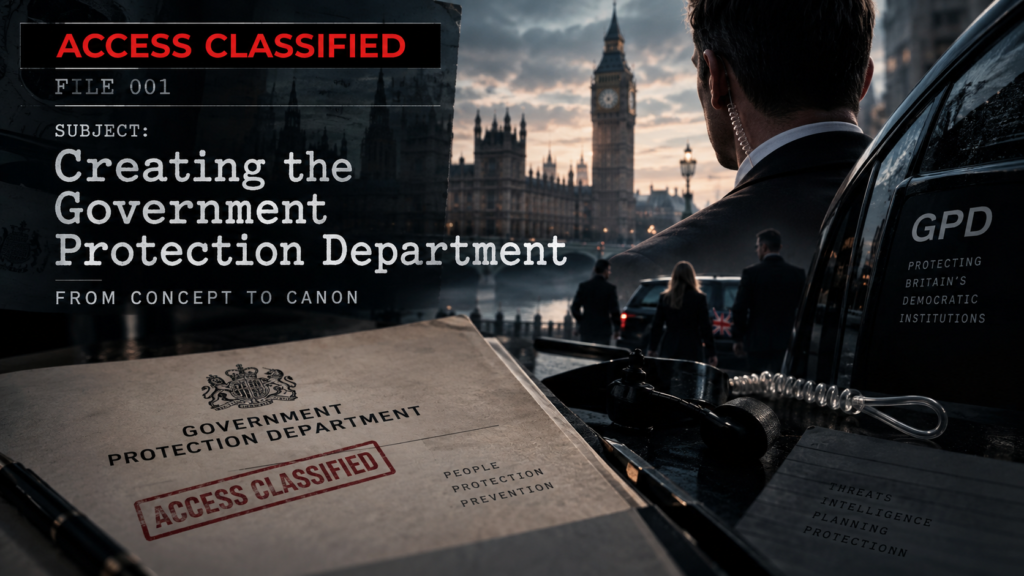
SUBJECT: Creating the Government Protection Department
CLASSIFICATION: ACCESS CLASSIFIED
When I started building The Prime Minister’s Daughter, I ran into a problem surprisingly early.
I needed somebody to protect the Prime Minister’s daughter.
That sounds simple enough.
It really wasn’t.
I knew from the beginning that I wanted the trilogy to feel British. Not vaguely British because everybody drinks tea and occasionally walks past Downing Street. I wanted the politics, policing, intelligence work and close protection to feel as though they belonged in the same world as the institutions surrounding the British Government.
But I also knew there was a line I didn’t want to cross.
I’m a novelist. I haven’t spent twenty years protecting Prime Ministers, and nobody has slipped me a classified manual explaining exactly how British close protection works behind closed doors.
So I had a choice.
I could take a real protection unit, change a few names and pretend I knew exactly how everything worked.
Or I could build my own.
That is how the Government Protection Department was born.
The problem with using a real organisation
There’s always a strange balancing act when you write fiction around real institutions.
Make everything completely fictional and there’s a danger that the world stops feeling believable.
Stick too closely to reality and suddenly you’re presenting things as fact that you simply cannot know.
That was particularly important with The Prime Minister’s Daughter because the protection operation isn’t just background decoration. It is fundamental to the story.
Luke Dawson couldn’t simply be the bloke in the suit who stands behind Lizzie looking suspiciously at everyone.
His job needed structure.
His team needed a chain of command. Somebody needed to assess threats. Somebody needed to plan movements and examine venues. Somebody needed to decide whether a piece of intelligence mattered.
And all of that needed to happen before Luke ever had to put himself between Lizzie and somebody trying to kill her.
Rather than simply renaming a real British protection unit, I created the Government Protection Department, or GPD.
That meant I could make it recognisably British without pretending it was a fictionalised version of an organisation that actually exists.
Building the Government Protection Department
Once I’d decided to create the Government Protection Department, there was another problem.
I couldn’t just give it a name.
If GPD only existed because Luke needed somewhere to work, readers would feel it. It would become one of those fictional organisations that conveniently has whatever power, equipment or department the plot requires that week.
So I started building backwards.
Why does the Government Protection Department exist?
Where did its officers come from?
What does it actually protect?
Who is in charge?
How does intelligence reach the people standing beside the principal?
And, most importantly, what does GPD consider successful protection?
In the world of The Prime Minister’s Daughter, the Government Protection Department is a relatively modern organisation. It was created as Britain’s security environment evolved and the traditional approach to executive protection needed to evolve with it.
It wasn’t created because of one enormous assassination or catastrophic security failure.
I deliberately avoided that.
Instead, its creation came from something much less dramatic and, to me, much more believable: the threats changed.
Terrorism evolved. Hostile states evolved. Technology evolved. Social media and open-source intelligence made information about people’s lives, movements and routines far easier to obtain.
The fictional British Government eventually decided that protection needed to become more intelligence-led.
The Government Protection Department was the result.
It brought together close protection, Protective Intelligence, advance planning and other specialist capabilities within one organisation.
Suddenly, I didn’t just have somewhere for Luke to work.
I had an entire world around him.
The Government Protection Department isn’t about gunfights
This was probably the most important thing I worked out while creating GPD.
Think about a protection officer in a thriller and you probably imagine the dramatic bit.
The gun comes out.
Somebody screams.
The protection officer throws themselves across the person they’re protecting.
Everybody runs.
And, yes, The Prime Minister’s Daughter has its share of moments where things go very badly wrong.
Luke Dawson doesn’t exactly get an easy first assignment as a Detail Leader.
But within the Government Protection Department, none of that represents the ideal outcome.
If Luke has reached the point where somebody is shooting at Lizzie, the system has already failed somewhere.
He may still save her life.
He may do absolutely everything right from that moment onwards.
But the bullet shouldn’t have reached her in the first place.
That became the central philosophy behind GPD:
Prevention over reaction.
Protection starts before Luke arrives
One of the things I wanted to get away from was the idea that close protection begins when Luke gets out of a car beside Lizzie.
By then, an enormous amount of work should already have happened.
Somebody should have assessed the threat.
Somebody should have examined the venue.
Somebody should have considered the route.
Somebody should have looked at the people causing concern.
Somebody should have taken intelligence from elsewhere and turned it into something Luke and his team can actually use.
That is where Protective Intelligence became such an important part of the Government Protection Department.
Its purpose isn’t to wait for somebody to attack Lizzie and then work out who they were.
Its purpose is to stop them getting close enough to attack her at all.
Within GPD, success isn’t measured by how many attackers Luke manages to stop.
It’s measured by how many attacks never happen.
And I really liked that idea because it changes the way you look at the action in the novel.
When everything goes quiet, the system might actually be working perfectly.
When the shooting starts, something has gone wrong.
Luke Dawson is the final layer
That also helped me enormously when I was creating Luke.
Luke is very good at his job.
At the beginning of The Prime Minister’s Daughter, he finally gets what he has spent his career working towards: command of his own close protection detail.
Unfortunately for him, his first principal is Elizabeth Wetherby.
Twenty years old.
The Prime Minister’s daughter.
And absolutely delighted at suddenly having a group of armed police officers following her everywhere.
Well…
Maybe not that last bit.
But Luke isn’t a one-man security service.
I never wanted him to become the action hero who somehow spots every threat, drives every vehicle, analyses every piece of intelligence, shoots every attacker and saves the day single-handedly.
The Government Protection Department doesn’t work that way.
Protection is layered.
Intelligence comes first.
Planning comes next.
There are people working ahead of the principal, people monitoring threats, people coordinating movements and people dealing with things Luke may never personally see.
Then, eventually, you reach Luke and the officers physically surrounding Lizzie.
Close Protection is the final physical layer.
If everything else works, Luke never has to draw his weapon.
If everything else fails, he’s the bloke standing between Lizzie and whatever got through.
That distinction became incredibly important to the way I wrote him.
What happens when prevention fails?
Of course, there’s a fairly obvious problem here.
I’m writing a political thriller.
Eventually, something is going to go horribly wrong.
When prevention fails, the Government Protection Department’s priorities become brutally simple.
Keep the principal alive.
Get them away from the threat.
Get them somewhere secure.
Work out what happened.
And make sure it cannot happen again.
But I didn’t want an assassination attempt to finish when the shooting stopped.
That’s where building the Government Protection Department properly became useful.
Because afterwards there are questions.
How did they get that close?
Was something missed?
Was the intelligence wrong?
Did somebody know something they shouldn’t have known?
Did the protection plan fail?
Or was the threat simply invisible until somebody pulled the trigger?
That creates tension between different parts of GPD without anybody necessarily being incompetent.
Luke can be furious because somebody nearly killed the person he was responsible for protecting.
Protective Intelligence can be equally frustrated because you cannot analyse information you don’t have.
Both sides can be right.
And that is considerably more interesting to me than somebody simply being crap at their job because the plot needs an assassin to get through.
The Government Protection Department doesn’t protect politicians
Technically, obviously, it does.
But this distinction became one of the most important parts of GPD.
The Government Protection Department doesn’t protect somebody because its officers agree with them.
It doesn’t protect a political party.
It doesn’t decide that one Prime Minister deserves better protection because an officer voted for them.
It protects the office.
The people inside GPD are protecting the democratic institutions that allow Britain to govern itself.
That means their personal politics are supposed to be irrelevant.
A Prime Minister is protected because they are the Prime Minister.
Another designated government figure is protected because the threat against them requires it.
Lizzie receives dedicated protection because being James Wetherby’s daughter has placed her at risk.
The officers don’t have to like the people they’re protecting.
They don’t even have to agree with them.
Their job is to make sure violence doesn’t get to decide who governs Britain.
Once I’d worked that out, I understood the Government Protection Department considerably better.
I also understood Luke Dawson better.
The six principles behind GPD
Eventually, I reduced the philosophy of the Government Protection Department to six principles.
Democracy before self.
Prevention over reaction.
Intelligence drives protection.
Professionalism without compromise.
Integrity without exception.
Service without recognition.
Those weren’t created simply to fill another page in my world-building notes.
They tell me how GPD officers are supposed to behave.
They tell me why Luke makes certain decisions.
They explain why somebody sitting behind a desk analysing threats can be just as important to Lizzie’s survival as the armed officer standing two feet away from her.
They also give me something considerably more interesting to play with across three books.
Because principles are easy when everybody agrees about what they mean.
They become much more complicated when powerful people start believing that breaking those principles is necessary to protect the country.
And that’s probably as far as I’m going with that one.
ACCESS CLASSIFIED, remember.
Why creating GPD was the right decision
The Government Protection Department started because I didn’t want to pretend I knew things about real British protection operations that I couldn’t possibly know.
It ended up becoming one of the foundations of The Prime Minister’s Daughter.
Creating GPD gave me freedom.
I can research the broad realities of close protection, policing, intelligence and British government security and use those principles to make the world believable.
But GPD remains fictional.
Its structure is mine.
Its history is mine.
Its procedures are fictional.
Its successes and failures belong to the story.
That means when something goes wrong, I’m not suggesting that a real British organisation would make the same mistake.
And when something works, I’m not pretending I’ve somehow discovered a classified operational procedure.
I’m writing fiction.
The trick is making the fiction feel real enough that, while you’re reading it, you forget that distinction.
ACCESS CLASSIFIED // WHAT SHOULD I OPEN NEXT?
The Government Protection Department started as the answer to a fairly simple question:
Where does Luke Dawson work?
It became something much bigger.
It gave Luke a career, a culture and a set of principles.
It gave the protection operation around Lizzie a structure.
And it gave the trilogy an organisation built around one fundamental belief:
Stop the attack before Luke ever has to stop the attacker.
Of course, if you’ve read anything about The Prime Minister’s Daughter, you’ll probably have worked out that things don’t always go according to plan.
This is ACCESS CLASSIFIED // FILE 001, and there is plenty more sitting inside the archive.
If you’ve enjoyed seeing how the Government Protection Department was created, share the post, leave a comment and tell me what you want me to open next. Luke Dawson? Lizzie Wetherby? Protective Intelligence? The close protection team? There are quite a few files marked classified.
To find out more about The Prime Minister’s Daughter, Luke Dawson and other operations, visit the ACCESS CLASSIFIED
ACCESS CLASSIFIED // END FILE 001