
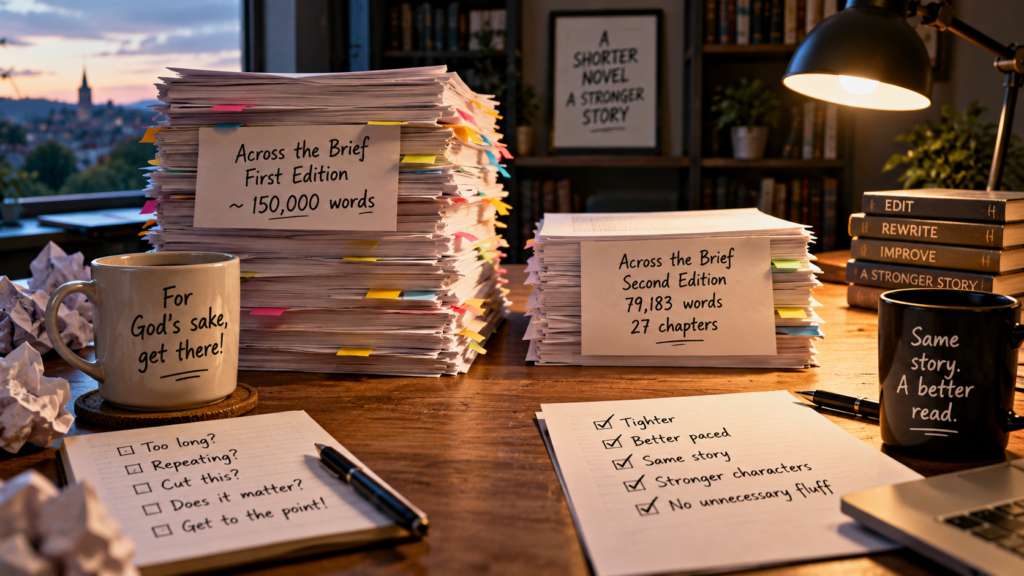
There’s something rather embarrassing about sitting down to read your own novel and discovering that you’re bored.
Not mildly distracted. Not struggling to concentrate because you’ve got other things on your mind.
Actually bloody bored.
That was the uncomfortable position I found myself in when I decided to revisit the First Edition of Across the Brief.
I’d written the thing. I knew the characters, the relationships, the twists and exactly where the story was going. Yet there I was, reading through my own work and thinking, For God’s sake, get there!
Conversations went on longer than they needed to. Scenes took forever to reach their point. Characters occasionally seemed determined to explain something the reader already knew.
And somewhere underneath all those words was a story I still genuinely believed in.
That was the frustrating part.
I didn’t think Across the Brief was a bad story. I thought it was a good story that I’d made unnecessarily difficult to read.
So I decided to do something about it.
What started as an attempt to tighten up a few things eventually became a complete rewrite and the publication of a Second Edition.
The result? A novel that originally weighed in at roughly 150,000 words now stands at 79,183 words across 27 chapters.
That’s approximately 70,000 words gone.
Which rather raises the question: what the bloody hell was I doing with all those words in the first place?
Why Did Across the Brief Need a Second Edition?
When I originally wrote Across the Brief, I was proud of what I’d achieved.
And I still am.
Writing a novel of that length, finishing it and getting it published is an achievement. Nobody can take that away from me.
But finishing a book and writing the best possible version of that book aren’t necessarily the same thing.
That’s something I’ve come to appreciate much more as I’ve continued writing.
When you’re working on a story, you become attached to things. A conversation you particularly enjoyed writing. A scene that took hours to get right. A little exchange between characters that makes you smile.
The problem is that just because you enjoyed writing something doesn’t mean the reader needs it.
And that was one of the biggest problems with the First Edition.
I had scenes that were doing the same job as other scenes. Conversations that reinforced things I’d already established. Explanations that might have been useful the first time but certainly didn’t need repeating.
Individually, some of those moments were perfectly fine.
Collectively, they were slowing the whole bloody book down.
The worst thing was that I could see it happening as I read.
I’d get to a scene, understand immediately what it was supposed to accomplish, and then spend several pages waiting for it to actually accomplish it.
That’s not exactly what you want from a novel.
Particularly when you’re the poor sod who wrote it.
Rewriting a Novel Is Harder Than It Sounds
Before starting the Second Edition, I had a fairly straightforward idea of what needed doing.
Keep the story. Keep the characters. Keep the important relationships and major events.
Get rid of the unnecessary stuff.
Simple, right?
Not remotely.
As I’ve discussed in an earlier article about why rewriting a novel can be harder than writing it the first time, the process creates a completely different set of problems from starting something new.
When you’re writing a new novel, you’ve got freedom.
You can introduce characters, change direction, develop relationships and discover things about the story as you go along.
Of course, you still need a plan. I’m not suggesting you should throw a load of characters onto a page and hope they sort themselves out.
Although, knowing some of mine, they’d probably give it a bloody good go.
But when you’re rewriting an existing novel, much of that freedom disappears.
You already know where the story is going.
You know which characters need to meet, which relationships need to develop and which events have consequences later.
You can’t simply remove something because it’s inconvenient without considering what that decision might break further down the line.
And that was probably the most frustrating part of the entire experience.
I wasn’t creating a completely new story. I was trying to tell an existing one better.
There were times when it genuinely felt as though I was trying to write with the handbrake on.
I could see ways of improving individual scenes, but every change had to fit into the bigger picture.
Quite frankly, there were moments when I wondered whether I’d have been better off writing another bloody novel instead.
Cutting 70,000 Words Without Losing the Story
Let’s talk about the numbers because they’re fairly ridiculous.
The First Edition was approximately 150,000 words.
The Second Edition is 79,183.
That’s a reduction of roughly 47 per cent.
Almost half the original manuscript.
Now, you might reasonably assume that removing that much material would leave enormous holes in the story.
Surely characters would disappear? Relationships would become less convincing? Important developments would be rushed?
That was certainly something I was determined to avoid.
The whole point of rewriting Across the Brief wasn’t to produce a shorter book simply for the sake of it.
If I’d wanted to do that, I could have gone through the manuscript deleting every other paragraph and called it a day.
It would have been quicker.
It would also have been bloody awful.
What I wanted was a stronger novel.
That meant looking at what each scene actually contributed.
Did it move the story forward? Did it develop a character? Did it reveal something important about a relationship? Did it create an emotional moment that mattered?
Or was it simply repeating something I’d already told the reader?
That last question became particularly important.
Because once I started looking properly, I discovered just how often I was explaining things that didn’t need explaining again.
Sometimes a character’s actions already told the reader everything they needed to know.
Sometimes a conversation could achieve in two pages what the original had taken six pages to accomplish.
And sometimes an entire scene could disappear without the story losing anything important.
But here’s the interesting thing.
Cutting words didn’t always mean making scenes shorter.
There were moments that actually needed more room to breathe.
Important emotional developments deserved attention. Relationships needed to feel convincing. Certain conversations couldn’t simply be rushed because I was trying to reduce the word count.
The trick was working out where those words mattered.
And where they didn’t.
Did I Lose Anything Important?
This was probably my biggest concern when I first started considering a Second Edition.
Because despite its problems, I still loved the story I’d written.
Across the Brief was never just about getting from one plot point to another.
The characters mattered to me. Their relationships mattered. The emotional journey mattered.
I didn’t want to turn the book into something completely different simply because I’d become a more experienced writer.
And I certainly didn’t want to strip out everything that gave the original story its personality.
When I first explained why I was considering rewriting Across the Brief, preserving the heart of the original novel was always part of the plan.
The Second Edition still tells the same essential story.
The central characters, their relationships and the major plot developments remain.
What has changed is how efficiently the story gets there.
Instead of repeatedly reminding readers how somebody feels, I’ve tried to let their behaviour and conversations do more of the work.
Instead of spending pages establishing something that’s already obvious, the story can move forward.
And instead of keeping a scene simply because I spent time writing it, I’ve been more willing to ask whether it actually deserves to be there.
That’s not to say every quiet moment has disappeared.
Far from it.
I still believe those smaller character moments are important. Sometimes a conversation over a cup of coffee can tell you more about a relationship than some enormous dramatic event.
But it has to earn its place.
That’s the difference.
Was Publishing a Second Edition Worth It for the Quality?
Absolutely.
And I don’t say that because I suddenly think I’ve written the greatest novel in the history of literature.
I’m fairly confident the literary world can survive without making that announcement.
I say it because I can see the difference between the two versions.
The Second Edition is tighter, more focused and much better paced.
The dialogue gets to the point without losing the characters’ personalities. The story doesn’t keep stopping to explain itself. The important moments have more impact because they’re no longer competing with so much unnecessary material.
Most importantly, I’m no longer sitting there wondering when my own bloody story is going to get moving.
Of course, whether every reader agrees with me is another matter.
Some people might prefer the First Edition.
They might enjoy the slower pace or appreciate details I’ve decided weren’t necessary.
And that’s fine.
Reading is subjective. What works for one person doesn’t necessarily work for another.
But as the author, I have to make decisions based on what I believe produces the strongest possible book.
And I’m much happier with the Second Edition.
Was Publishing a Second Edition Worth It Financially?
Now there’s a question.
And the answer is that I haven’t got a bloody clue yet.
I’d love to sit here and tell you that rewriting Across the Brief has transformed its commercial fortunes.
That sales have exploded, readers are queuing around the block and I’m currently deciding which Caribbean island to buy.
Unfortunately, reality has a nasty habit of getting in the way of a good story.
The truth is that I won’t know whether publishing a Second Edition was financially worthwhile until there’s enough sales information to make a meaningful comparison.
And even then, it won’t necessarily be straightforward.
A book’s commercial performance depends on far more than the quality of the writing.
Visibility matters. Marketing matters. Reviews matter. Getting the book in front of the right readers matters.
You can write a fantastic novel, but if nobody knows it exists, you’re going to struggle to sell it.
Equally, there are books that sell extraordinarily well despite being, shall we say, not exactly literary masterpieces.
So I’m not going to pretend that cutting 70,000 words automatically means selling more copies.
It doesn’t.
And I certainly wouldn’t recommend that every independent author rush out and rewrite their previous novels in the hope of making a fortune.
That would be a rather expensive way of discovering that publishing doesn’t come with guarantees.
Financially, the jury is still out.
And it might remain out for quite some time.
Was Rewriting Across the Brief Worth It for Me as a Writer?
Hell yeah.
In fact, this might be the most important part of the whole experience.
Because rewriting Across the Brief forced me to confront something that isn’t always particularly comfortable.
My own mistakes.
When you finish writing a novel, there’s a temptation to concentrate on what you’ve achieved.
You’ve completed the manuscript. You’ve worked through the edits. You’ve published the book.
Job done.
Except writing doesn’t work like that.
Or at least, improving as a writer doesn’t.
You have to be willing to look back at your own work and admit that certain things could have been done better.
And sometimes considerably better.
That’s not always easy when you’ve spent months pouring your time and energy into something.
Nobody particularly enjoys discovering that a scene they were once proud of is now putting them to sleep.
But I think it’s necessary.
The Second Edition made me much more aware of pacing, repetition and the difference between developing a character and repeatedly telling readers what they already know about them.
It also taught me to be more ruthless.
Not ruthless for the sake of it.
I’m not suddenly going to start cutting every paragraph that doesn’t contain a dramatic revelation or somebody getting punched.
But I am more conscious of whether a scene is earning its place in the story.
And that’s something I can carry into every novel I write from now on.
If the experience helps me recognise those problems earlier in future manuscripts, then it has already achieved something worthwhile.
Because I’d much rather fix those issues while writing the first draft than discover them after publishing another 150,000-word monster.
Once was quite enough, thank you.
Would I Rewrite Another Published Novel?
That’s an interesting question.
And I’m not entirely sure I’d rush to do it again.
Not because I regret rewriting Across the Brief, but because I now understand just how much work is involved.
A Second Edition isn’t necessarily a quick tidy-up.
Certainly not when you’re effectively rebuilding the book from the ground up.
There are decisions to make about structure, pacing, character development and continuity. And unlike writing something new, you can’t always follow an interesting idea wherever it takes you.
Sometimes you have to remind yourself that the objective is to improve the existing story, not replace it with something else.
That can be surprisingly restrictive.
And, quite frankly, frustrating.
There were times when I missed the freedom of starting a new project. The excitement of not knowing exactly how a scene might develop or discovering something unexpected about a character.
With Across the Brief, I already knew the destination.
My job was to find a better route.
Would I do it again if I genuinely believed another published novel needed that level of work?
Yes, probably.
But I certainly wouldn’t make a habit of it.
I’d much rather apply what I’ve learnt to the books I’m writing now and hopefully avoid needing another Second Edition in the first place.
The Biggest Lesson Wasn’t About Cutting Words
It’s tempting to look at the difference between 150,000 words and 79,183 words and assume that’s the achievement.
And don’t get me wrong, removing approximately 70,000 words from a novel without destroying the story is something I’m pleased about.
But the word count isn’t really the point.
A shorter novel isn’t automatically a better novel.
Just as a longer novel isn’t automatically more substantial.
Some stories need 150,000 words. Others can be told brilliantly in 70,000.
The important thing is whether those words are doing something worthwhile.
And I think that was the mistake I made with the First Edition.
I confused length with substance.
I sometimes allowed scenes to continue because there was more I could write, rather than because there was more the reader needed.
I gave characters opportunities to repeat themselves when their point had already been made.
And I occasionally treated detail as though adding more of it automatically made a scene richer.
It doesn’t.
Sometimes it just makes the reader impatient.
I know that because I became that impatient reader.
Of my own bloody book.
The Second Edition taught me that being economical with words doesn’t mean sacrificing emotion, personality or depth.
It means being more deliberate about where you put them.
And that’s a lesson I wish I’d learnt a little earlier.
Although, to be fair, I probably wouldn’t have understood it quite so well without going through this experience.
So, Was Rewriting Across the Brief Worth It?
Yes.
Without hesitation.
Was it always enjoyable? Absolutely not.
Was it more difficult than I expected? Definitely.
Did I occasionally wonder why I’d decided to make so much extra work for myself?
You can probably guess the answer to that one.
But when I look at the finished Second Edition, I can see what the effort achieved.
The story is still there. The characters are still there. The relationships and emotional moments that made me want to write Across the Brief in the first place are still there.
They just don’t have to fight their way through another 70,000 words to be noticed.
I can’t promise the Second Edition will sell more copies than the First.
I can’t even promise that every reader will prefer it.
But I can say that I’m happier with the book I’ve published.
And perhaps more importantly, I’m a better writer for having gone through the process.
There’s also something rather satisfying about returning to a novel you once struggled to read and finally feeling that it tells the story you wanted to tell.
Because ultimately, that was why I started this whole exercise.
I was bored by my own novel.
And I didn’t think that was good enough.
Now, when I look at Across the Brief, I don’t see a story buried underneath far too many words.
I see the novel I was trying to write all along.
And for me, that makes the whole bloody exercise worthwhile.
Over to You – Would You Give a Novel a Second Chance?
Now I’m interested in what you think.
Have you ever read a novel that had a fantastic story but seemed to take forever to get anywhere? Or have you gone back to a book you previously enjoyed and wondered why you were so impressed the first time?
And here’s another question: would you buy a Second Edition of a novel you’d already read if the author had substantially rewritten it?
I’d genuinely love to know.
Share your thoughts in the comments, whether you’re a reader, a fellow writer or somebody who thinks I’ve completely lost the plot by rewriting an entire novel.
And if you’d like to discover more about Across the Brief, explore my other novels or follow what I’m working on next, head over to CMeewrites.
You never know. You might even find something worth reading.
Preferably something that doesn’t make you shout, “For God’s sake, get there!”