
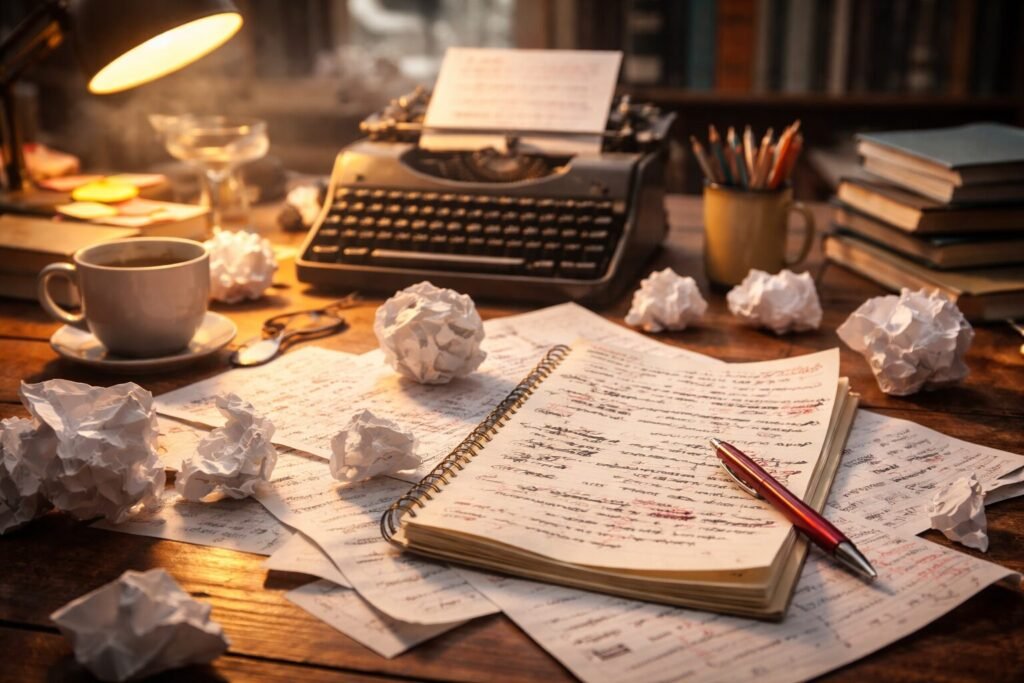
First drafts aren’t meant to impress anyone. They’re not meant to be polished, profound, or publishable.
They’re meant to exist.
That’s it.
If you’ve already moved from writing just for fun into writing with intent (I broke that down properly in this post: Writing for Fun vs Writing with Intent), then you already know your story. You’ve planned it. You understand your characters. You’ve mapped the structure.
Now comes the uncomfortable part.
Getting it out of your head and onto the page.
And here’s the core of my first draft writing advice:
Your first draft is allowed to be a complete mess.
First Draft Writing Advice: Stop Trying to Impress Anyone
One of the biggest problems writers face is trying to make Draft One look like Draft Five.
It won’t.
It can’t.
The first draft isn’t the finished house. It’s the scaffolding. It’s the messy blueprint. It’s you telling yourself the story for the first time.
Dialogue will feel clunky.
Pacing will wobble.
Scenes will drag or sprint.
You’ll contradict yourself.
That’s normal.
Solid first draft writing advice isn’t “write beautifully”.
It’s “write freely”.
If you try to polish every paragraph as you go, you’ll stall. You’ll rewrite Chapter One ten times and never see Chapter Four.
Perfectionism doesn’t improve a first draft. It kills momentum.
My First Drafts Are Always a Mess (And That’s Fine)
I’ll be honest with you.
I’ve got manuscripts that didn’t see daylight until the fifth or sixth draft.
Sometimes I don’t even finish the first one.
Sometimes I delete it.
Sometimes I keep it because I can see exactly where it went wrong.
Sometimes I start again from scratch because it’s easier than patching a rushed beginning.
That’s something most basic first draft writing advice doesn’t tell you — you will rush.
You’ll try to cram every good idea into the first few chapters.
You’ll speed through emotional beats that needed breathing room.
You’ll realise halfway through that the pacing is off.
That isn’t failure.
That’s discovery.
Draft One shows you what the story actually is — not what you imagined it to be.
First Draft Writing Advice for Overthinkers
If your brain runs faster than your fingers, you’ll relate to this.
You want every twist in immediately.
You want every emotional moment nailed.
You want it to feel powerful from page one.
But stories need space.
A messy draft exposes where you’ve overstuffed it. It reveals where you’ve sprinted instead of built tension. It gives you a bird’s-eye view so you can fix it properly in Draft Two.
Mess shows you structure.
That’s why allowing chaos in Draft One actually improves the finished book.
Using Tools (Including AI) Without Losing Your Voice
I’m going to be completely straight with you.
I use AI to help me write my books.
Not because I can’t write.
Not because I’m cutting corners.
But because I’m disabled and I physically can’t type quickly. If I wrote every word myself at full length, it would take me years to release a single book.
Does that make me an “AI author”?
No.
AI can’t write a book without direction. It doesn’t know my characters. It doesn’t understand my pacing. It doesn’t feel the emotional beats unless I guide it there.
I give detailed prompts.
I know exactly what I want from a scene.
When it generates something, I go through it carefully. If it’s not right, I adjust the prompt. If it still isn’t right, I refine it again.
It’s a tool.
And even with tools, my first drafts are still messy.
Because messy is part of the process.
The tool doesn’t remove the creative responsibility. It just supports the physical workload.
That still fits within honest, practical first draft writing advice: get the story down first. Improve it later.
Permission Is Powerful
Here’s the most important piece of first draft writing advice in this entire post:
Permission changes everything.
When you give yourself permission to write badly:
You move faster.
When you move faster, you finish.
When you finish, you can improve.
You cannot edit a blank page.
You can reshape something rough.
You can refine something clumsy.
You can strengthen something uneven.
But you cannot fix nothing.
A messy manuscript is clay.
A blank document is air.
Choose clay.
Progress Over Perfection
Your first draft is not meant to resemble the finished product.
It’s meant to capture the idea before it disappears.
Draft Two shapes it.
Draft Three tightens it.
Draft Four sharpens it.
Draft Five makes it strong.
If you quit because Draft One looks chaotic, you never reach the good version.
Every book you admire once looked like a disaster.
That’s normal.
That’s writing.
Let’s Make This Practical
If you’re stuck right now, here’s your challenge:
Stop editing.
Stop polishing.
Stop rereading Chapter One for the twentieth time.
Push forward.
Finish the draft messy.
Then fix it.
That’s real-world, no-nonsense first draft writing advice.
Are you stuck perfecting the opening?
Or are you brave enough to power through the chaos?
Drop a comment and tell me where you are in your draft.
And if you want more straight-talking writing advice without the romantic nonsense, head over to CMeewrites and explore The Writing Room.
Mess first. Polish later.
That’s how books get finished.